So, you’ve decided to chase that Probationary Officer badge in 2026. Good choice. But before you open a single mock test, you need to know exactly what to prepare. That’s what this guide is for.
The IBPS PO Exam Pattern 2026 has actually changed this year, and if you’re still studying from an old PDF you saved in 2023, you might be preparing for the wrong exam. IBPS has revised the Mains structure under the IBPS PO (CRP PO/MT-XVI) notification, and the changes are big enough to affect how you plan your months of preparation.
In this guide, we’ll go through by covering revised Exam Pattern of Prelims, Mains, the descriptive paper, the interview, and section-wise weightage.
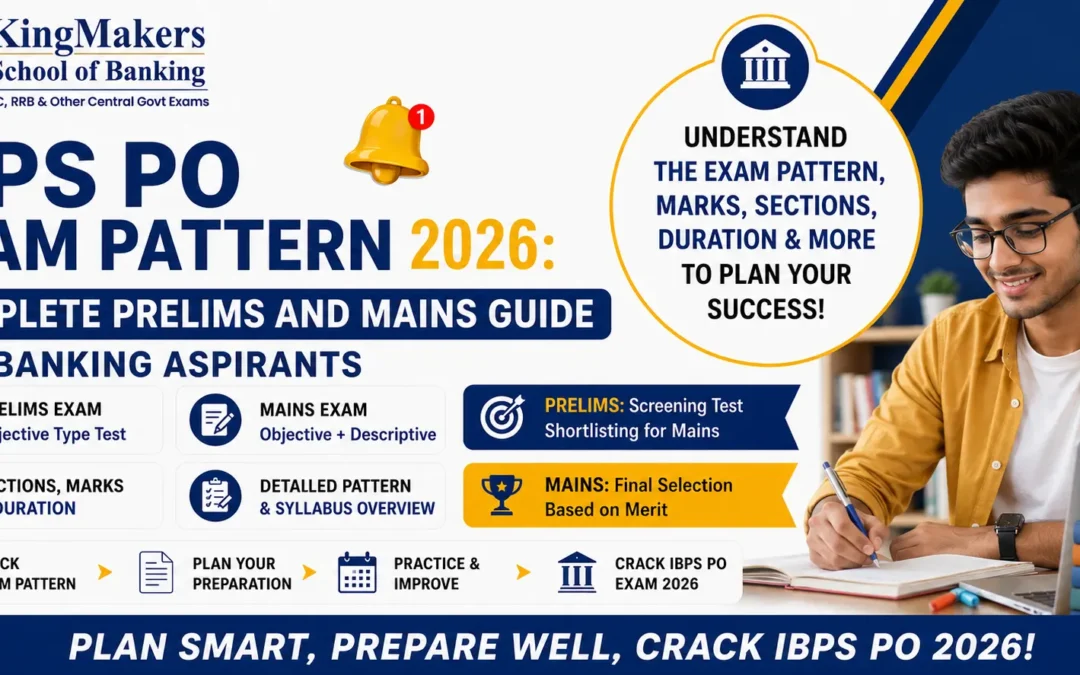
Quick Overview: IBPS PO Exam Pattern 2026 at a Glance
If you’re in a hurry, here’s the short version.
| Stage | Questions | Marks | Duration |
|---|---|---|---|
| Prelims | 100 | 100 | 60 minutes |
| Mains – Objective | 170 | 200 | 160 minutes |
| Mains – Descriptive | 2 | 25 | 30 minutes |
| Interview | — | 100 | — |
Final selection is based on Mains and Interview marks combined in an 80:20 ratio. Prelims is only a qualifying round; its marks don’t count toward your final rank.
What Is the IBPS PO Selection Process 2026?
Before jumping into marks and timing, it helps to see the full picture of how a candidate becomes a bank officer.
The selection process this year runs across four stages:
- Preliminary Examination – a qualifying screening round
- Main Examination – objective plus descriptive test
- Personality Test – a newly added, non-qualifying but mandatory step
- Common Interview – the final face-to-face round
You have to clear each stage before moving to the next. There’s no shortcut Prelims filters the crowd, Mains does the heavy lifting for your rank, and the Interview polishes the final list.
IBPS PO Prelims Exam Pattern 2026
Think of Prelims as the entry gate. It’s not meant to test deep knowledge, it checks your speed, accuracy, and basic command over three subjects.
The Prelims paper has 100 questions worth 100 marks, and you get 60 minutes total. But here’s the catch: it’s not one continuous 60-minute block. Each section has its own sectional timing of 20 minutes, so you can’t borrow extra time from English to finish your Quantitative section faster.
| Section | Questions | Marks | Time |
|---|---|---|---|
| English Language | 30 | 30 | 20 minutes |
| Quantitative Aptitude | 35 | 30 | 20 minutes |
| Reasoning Ability | 35 | 40 | 20 minutes |
| Total | 100 | 100 | 60 minutes |
Notice that Reasoning Ability carries the highest marks among the three sections. That’s a small but useful clue: spend a little extra practice time on puzzles, seating arrangements, and inequalities, since this section alone can swing your overall score.
Also remember, Prelims only decides whether you move forward. Your actual rank comes later. So even a candidate who scores modestly here but performs strongly in Mains can still land a good bank.
Negative Marking in Prelims
Every wrong answer costs you 0.25 marks. Unanswered questions carry no penalty. So a smart strategy is simple: attempt what you’re sure of, skip pure guesswork, and don’t let silly mistakes eat into your score.
IBPS PO Mains Exam Pattern 2026 (Revised)
This is where the real competition happens and where 2026 brings the biggest shake-up.
Earlier years had 145 objective questions in Mains. This year, IBPS has pushed that number up to 170 questions, while keeping the total marks unchanged at 200. The time given has actually gone down slightly too, from 190 minutes to 160 minutes for the objective paper. In short: more questions, less time. That means calm, efficient attempts matter more than ever.
The Mains exam has two parts: an Objective Test and a Descriptive Test and you need to clear both.
Mains Objective Test Structure
| Section | Approx. Questions | Marks | Time |
|---|---|---|---|
| Reasoning & Computer Aptitude | High weightage section | Combined with DI, around 120 marks | Sectional |
| Data Analysis & Interpretation | High weightage section | Combined with Reasoning, around 120 marks | Sectional |
| English Language | Moderate weightage | Remaining marks | Sectional |
| General / Economy / Banking Awareness | 50 | 60 | Sectional |
| Total | 170 | 200 | 160 minutes |
A quick note: IBPS has confirmed the total of 170 questions, 200 marks, and the General Awareness section’s exact split (50 questions for 60 marks). The precise question-wise split within Reasoning, Data Analysis, and English can shift slightly between notifications, so it’s always worth cross-checking the exact numbers against the official PDF once you’ve registered. What stays fairly consistent, based on past patterns, is that Reasoning & Computer Aptitude and Data Analysis & Interpretation together carry the lion’s share of marks, usually over half the objective paper. If you’re deciding where to invest your practice hours, start there.
Section-Wise Weightage: Where Should You Focus?
Here’s a simplified way to think about weightage distribution in Mains:
- Reasoning & Data Analysis (combined): The heaviest zone. Expect puzzles, seating arrangements, caselets, and data-heavy questions that eat up time. Master this, and your overall score jumps significantly.
- General/Banking Awareness: The fastest-scoring section if you’ve kept up with current affairs. No calculations, no lengthy passages just recall.
- English Language: Tests reading comprehension, grammar accuracy, and vocabulary in context. Consistent daily reading habits pay off here.
- Computer Aptitude: Merged with Reasoning. Usually basic digital banking terms, number systems, internet basics, nothing you can’t learn in a couple of weeks.
A practical tip: many toppers attempt General Awareness first in Mains because it takes the least time and builds confidence before tackling the tougher analytical sections.
Mains Descriptive Test 2026
Once the objective paper ends, you move into the Descriptive Test 25 marks, 30 minutes, conducted in English.
Here’s the 2026 update worth noting: the descriptive format has shifted from the older Essay and Letter Writing combination to Essay and Comprehension. So instead of practicing formal or informal letters, focus your descriptive prep on writing structured essays and answering comprehension-based questions with clarity.
IBPS has also indicated that this paper may be evaluated using an automated scoring system. What does that mean for you practically? Write clean, grammatically sound, well-organised answers. Quality of content matters more than quantity of words.
Total time for the entire Mains exam objective plus descriptive works out to 190 minutes, or a little over three hours. Pace yourself accordingly.
Negative Marking in Mains
Same rule as Prelims: 0.25 marks deducted for every wrong answer in the objective sections. The descriptive paper has no negative marking, but poor structure or irrelevant content can still cost you marks during evaluation.
IBPS PO Interview and Personality Test 2026
Cleared Mains? You’re not done yet, but you’re close.
A new addition this year is the Personality Test, conducted after the Mains result. It’s mandatory for shortlisted candidates but non-qualifying, meaning you won’t be eliminated based on it directly; however, your personality profile from this test is shared with the interview panel. So while it won’t disqualify you, it does shape how the panel perceives you.
The Common Interview carries 100 marks and checks your communication skills, awareness of banking and current affairs, confidence, and overall suitability for an officer’s role.
To clear this stage, you need at least:
- 40% marks for general category candidates
- 35% marks for SC/ST/OBC/PwBD candidates
Final Merit List: The 80:20 Formula
Here’s the part every aspirant should tattoo on their brain: your final selection depends only on Mains and Interview marks, combined in an 80:20 ratio. Prelims marks are completely dropped once you qualify.
This means a strong Mains performance can carry you a long way, even if your interview is just decent. But a weak Mains score is very hard to recover from no amount of interview charm fixes that gap. Plan your energy accordingly: Prelims gets you through the door, but Mains wins you the job.
Exam Mode, Language, and Centres
The entire IBPS PO exam Prelims and Mains is conducted online. You’ll take it at a computer-based test centre allotted by IBPS.
During registration, you get to do a bit of search and place preference, meaning you search through the list of available exam cities and place your preferred choices in order. IBPS tries to honour your preference where possible, but if seats run out at your chosen centre, they may assign you elsewhere. You can’t request a change later, so choose thoughtfully during the application itself.
Question papers are available in both English and Hindi, except for the English Language section, which is obviously tested only in English.
Key Differences: Prelims vs Mains at a Glance:
| Feature | Prelims | Mains |
|---|---|---|
| Nature | Qualifying only | Counts toward final merit |
| Questions | 100 | 170 (objective) + 2 (descriptive) |
| Total Marks | 100 | 225 (200 + 25) |
| Duration | 60 minutes | 190 minutes |
| Sections | 3 | 4 objective + 1 descriptive |
| Negative Marking | Yes (0.25) | Yes (0.25), none for descriptive |
Preparation Tips Based on the Revised Pattern
- Practice under real time pressure. With 170 questions in 160 minutes for Mains, speed without accuracy won’t help. Time yourself strictly during mocks.
- Don’t skip the descriptive paper. Since it’s now Essay and Comprehension, read editorials regularly and practice summarising them in your own words.
- Prioritise Reasoning and Data Analysis. These sections carry the heaviest combined weightage building strong fundamentals here has the biggest payoff.
- Treat General Awareness as a daily habit, not a last-minute cram session. Sixty marks from pure recall is too good to leave on the table.
- Take sectional mocks, not just full-length ones. Since every section is separately timed, practising sections in isolation trains you better for the real exam-day rhythm.
Key Takeaway
If there’s one takeaway from all of this, it’s that the IBPS PO Exam Pattern 2026 rewards candidates who prepare smart, not just hard. Know where the marks are, manage your sectional time, and treat the descriptive paper with the same seriousness as the objective test. Do that consistently , it’s the right time to begin your preparation with a structured study plan. Explore our comprehensive Specialist Officer preparation resources, including updated syllabus, exam pattern, study materials, mock tests, and expert guidance to boost your chances of success.
Frequently Asked Questions
It consists of three stages: Prelims (100 marks), Mains (225 marks including the descriptive paper), and an Interview (100 marks). Final selection is based on Mains and Interview marks combined in an 80:20 ratio.
Yes. The number of objective questions has increased from 145 to 170, while total marks remain 200. The exam duration for the objective paper has also been reduced from 190 to 160 minutes, and the descriptive paper now covers Essay and Comprehension instead of Essay and Letter Writing.
Yes. Both stages have fixed sectional timing. You must complete each section within its allotted time and cannot shift extra time to another section.
25 marks are deducted for every wrong answer in the objective sections of both Prelims and Mains. There's no penalty for unattempted questions, and the descriptive paper has no negative marking.
No. Prelims is purely qualifying. Only your Mains and Interview marks, combined in an 80:20 ratio, decide your final rank.
It's a new, mandatory but non-qualifying assessment conducted after Mains for shortlisted candidates. It doesn't disqualify you on its own, but the resulting personality profile is shared with your interview panel.
Reasoning & Computer Aptitude and Data Analysis & Interpretation together carry the largest combined share of marks in the objective paper, making them the most important sections to master.
Candidates need at least 40% in the interview for the general category and 35% for SC/ST/OBC/PwBD candidates to remain in contention for the final merit list.