Preparing for IBPS RRB in just 30 days can feel challenging, especially when you have multiple subjects to cover. However, a focused preparation strategy can help you make the most of the available time.
Instead of trying to complete every topic, focus on important concepts, previous-year questions, mock tests, revision, speed and accuracy.
Your preparation will also depend on the post you are targeting. Office Assistant and Officer Scale-I have Prelims followed by Mains, while Officer Scale-II and Scale-III have a Single Level Examination followed by an interview.
This 30-day IBPS RRB study plan will help you organise your preparation and focus on the areas that matter most.
Can I Prepare for IBPS RRB in 30 Days?
Yes, 30 days can be used effectively for focused IBPS RRB preparation, especially if you already have a basic understanding of the subjects.
The key is to avoid trying to learn everything at once. Instead, concentrate on:
- Important and frequently practised topics
- Previous-year questions
- Sectional and full-length mock tests
- Current Affairs and Banking Awareness
- Daily revision
- Speed and accuracy
- Mistake analysis
If you are starting from the basics, spend the first few days strengthening fundamental concepts before moving to intensive practice.
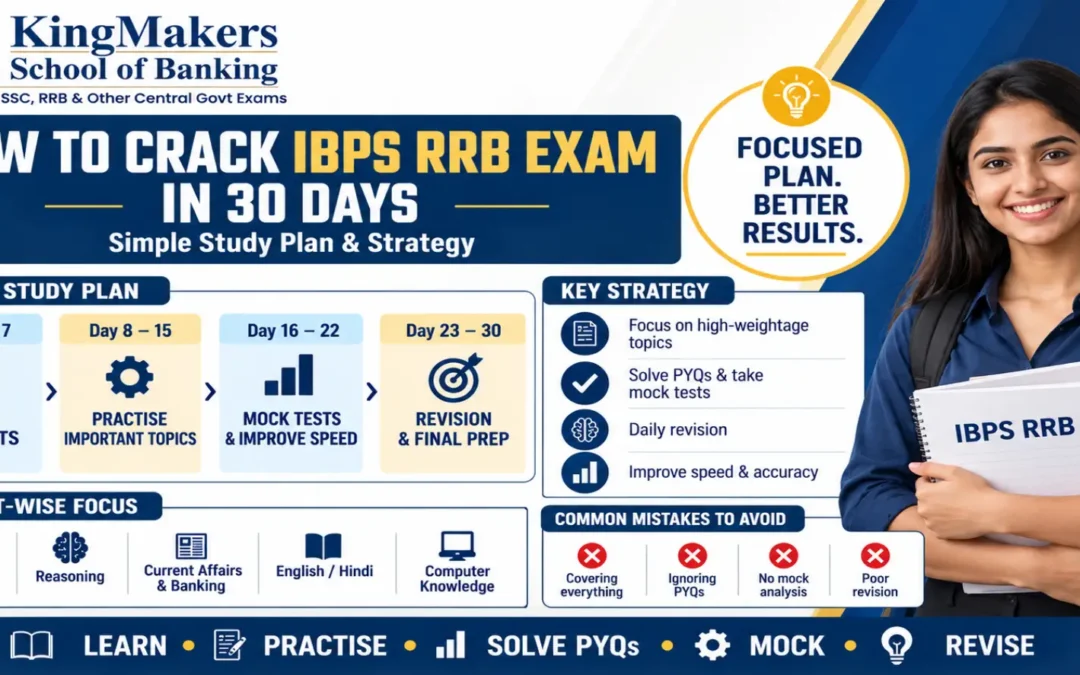
IBPS RRB 30-Day Study Plan
Divide your preparation into four stages rather than studying randomly.
Days | Focus | What to Do |
Day 1–7 | Build the Base | Revise concepts, identify weak areas and start topic-wise practice |
Day 8–15 | Intensive Practice | Practise important topics and solve previous-year questions |
Day 16–22 | Speed & Accuracy | Take sectional tests and start regular full-length mocks |
Day 23–27 | Mock & Revision | Analyse mocks, revise weak areas and strengthen Current Affairs |
Day 28–30 | Final Revision | Revise formulas, notes, Current Affairs and previous mistakes |
Subject-Wise IBPS RRB Preparation Strategy
1. Reasoning Ability
Focus on topics that regularly require practice:
- Puzzles and Seating Arrangement
- Syllogism
- Inequality
- Coding-Decoding
- Blood Relations
- Direction Sense
- Ranking
- Alphanumeric Series
- Input-Output
- Data Sufficiency
Start with shorter topics and gradually increase your practice of puzzles and seating arrangements.
Daily target: Practise at least 2–3 reasoning sets and analyse your mistakes.
2. Numerical Ability / Quantitative Aptitude
Prioritise:
- Simplification and Approximation
- Number Series
- Quadratic Equations
- Percentage
- Ratio and Proportion
- Average
- Profit and Loss
- Simple and Compound Interest
- Time and Work
- Time, Speed and Distance
- Data Interpretation
Revise important formulas and practise calculations every day.
Do not spend too much time on one difficult question. Learn to identify questions that can be solved quickly.
3. General Awareness & Current Affairs
For Mains preparation, give regular attention to:
- Banking Awareness
- Current Affairs
- RBI
- NABARD
- Government Schemes
- Financial Inclusion
- Banking Terms
- Rural Banking
- Important Financial Developments
Spend some time every day reading and revising Current Affairs rather than leaving the entire section for the last week.
4. Computer Knowledge
For Mains, revise:
- Computer Fundamentals
- Hardware and Software
- Operating Systems
- Internet
- Networking
- MS Office
- Database Basics
- Cyber Security
- Computer Terminology
Short notes and objective-question practice can make revision easier.
5. English / Hindi Language
Depending on your chosen language, focus on:
- Reading Comprehension
- Cloze Test
- Error Detection
- Fill in the Blanks
- Para Jumbles
- Sentence Improvement
- Grammar
- Vocabulary
Practise reading and comprehension regularly instead of relying only on memorisation.
6. Financial Awareness for Officer Posts
Candidates preparing for Officer Scale-II and Scale-III should also give attention to:
- RBI and NABARD
- Banking System
- Monetary Policy
- Financial Institutions
- Government Schemes
- Financial Inclusion
- Rural Banking
- Recent Financial Developments
For Specialist Officer posts, also prepare the Professional Knowledge section according to the applicable syllabus.
Daily Study Plan for IBPS RRB
A simple daily schedule can help you stay consistent.
Study Area | Suggested Time |
Quantitative/Numerical Ability | 2 Hours |
Reasoning | 2 Hours |
Current Affairs & Banking Awareness | 1–1.5 Hours |
English/Hindi | 1 Hour |
Computer Knowledge | 45 Minutes |
Mock/Sectional Test + Analysis | 1–1.5 Hours |
If you are working or studying alongside your preparation, adjust the timings according to your schedule. Consistency is more important than following a fixed number of study hours.
Previous-Year Questions and Mock Tests
Mock tests and PYQs should become an important part of your preparation during the final 30 days.
After every test, check:
- Which questions were incorrect?
- Which topics caused mistakes?
- Which questions took too much time?
- Which easy questions did you miss?
- Were any mistakes caused by calculation or guessing?
Maintain a simple error notebook and revise it regularly.
Remember:
Mock Test → Analyse → Identify Weakness → Practise → Retest
Simply taking multiple mocks without analysing them will not help you improve effectively.
Common Mistakes to Avoid While Preparing for IBPS RRB Exam
Avoiding common preparation mistakes is just as important as following a study plan.
Trying to Cover the Entire Syllabus: With only 30 days, trying to master every topic can leave you with little time for revision. Prioritise important topics and strengthen the areas where you can improve.
- Using Too Many Study Materials: Switching between multiple books, PDFs, apps and video courses can waste valuable preparation time. Choose reliable resources and revise them properly.
- Ignoring Previous-Year Questions: Only studying concepts is not enough. PYQs help you understand the types of questions asked and identify topics that need more practice.
- Taking Mock Tests Without Analysis: Your mock-test score alone does not show where you need improvement. Spend time reviewing wrong answers, skipped questions and time-consuming questions.
- Neglecting Current Affairs: Current Affairs and Banking Awareness require regular revision. Avoid leaving the entire section for the final few days.
- Spending Too Much Time on One Question: Getting stuck on a difficult question can affect your performance in the rest of the section. Practise identifying questions that should be attempted, skipped or revisited.
- Ignoring Revision: Learning new topics every day without revising previously studied concepts can reduce retention. Keep dedicated time for revision throughout the 30 days.
- Changing Your Strategy at the Last Minute: Avoid experimenting with completely new study methods or attempting unfamiliar topics just before the exam. Use the final days for revision, practice and preparation.
Prelims and Mains Preparation
Your preparation should match your target post.
Office Assistant
Prelims: Reasoning + Numerical Ability
Mains: Reasoning + Numerical Ability + General Awareness + Computer Knowledge + English/Hindi
Officer Scale-I
Prelims: Reasoning + Quantitative Aptitude
Mains: Reasoning + Quantitative Aptitude + General Awareness + Computer Knowledge + English/Hindi
Officer Scale-II & III
These posts have a Single Level Examination, followed by an interview. Candidates should therefore prepare the complete applicable syllabus, including the relevant professional or specialised section.For Specialist Officer posts, also prep
Always refer to the latest official notification for the syllabus and examination structure applicable to your post.
Last 3 Days Before the Exam
During the final three days, focus on revision rather than learning large new topics.
Revise:
- Quantitative Aptitude formulas
- Reasoning concepts
- Current Affairs
- Banking Awareness
- Computer Knowledge
- Important vocabulary
- Previous mistakes
- Frequently practised questions
Also make sure you understand your mock-test strategy and time management approach.
Final 30-Day IBPS RRB Strategy
A successful 30-day preparation plan is not about studying continuously. It is about studying the right topics, practising regularly and learning from your mistakes.
Follow this simple cycle throughout your preparation:
Learn → Practise → Solve PYQs → Take Mock Tests → Analyse → Revise
Stay consistent, avoid unnecessary study material and keep your preparation aligned with the post you are targeting.
For structured preparation, mock tests, study material and expert guidance, explore the IBPS RRB coaching programmes at KingMakers School of Banking.
Frequently Asked Questions
Yes. A focused 30-day plan can help improve your preparation, particularly if you already have a basic understanding of the core subjects.
There is no fixed number of hours required. Focus on consistent and distraction-free study sessions based on your available time.
For Office Assistant and Officer Scale-I Prelims, prioritise Reasoning and Numerical Ability/Quantitative Aptitude. Alongside these, gradually prepare the subjects required for Mains.
Yes. PYQs help you understand question patterns, identify important topics and improve your exam readiness.
Rather than focusing only on the number of mocks, focus on taking regular tests and analysing every mistake. Increase full-length mock practice during the final two weeks.
Yes. Timed practice, regular mock tests, calculation practice and better question selection can help improve speed and accuracy.
For Office Assistant and Officer Scale-I, it is useful to gradually prepare Mains subjects alongside Prelims rather than waiting until the Prelims stage is over.
Focus on revision, Current Affairs, formulas, important concepts, previous mistakes and light practice. Avoid starting large new topics.