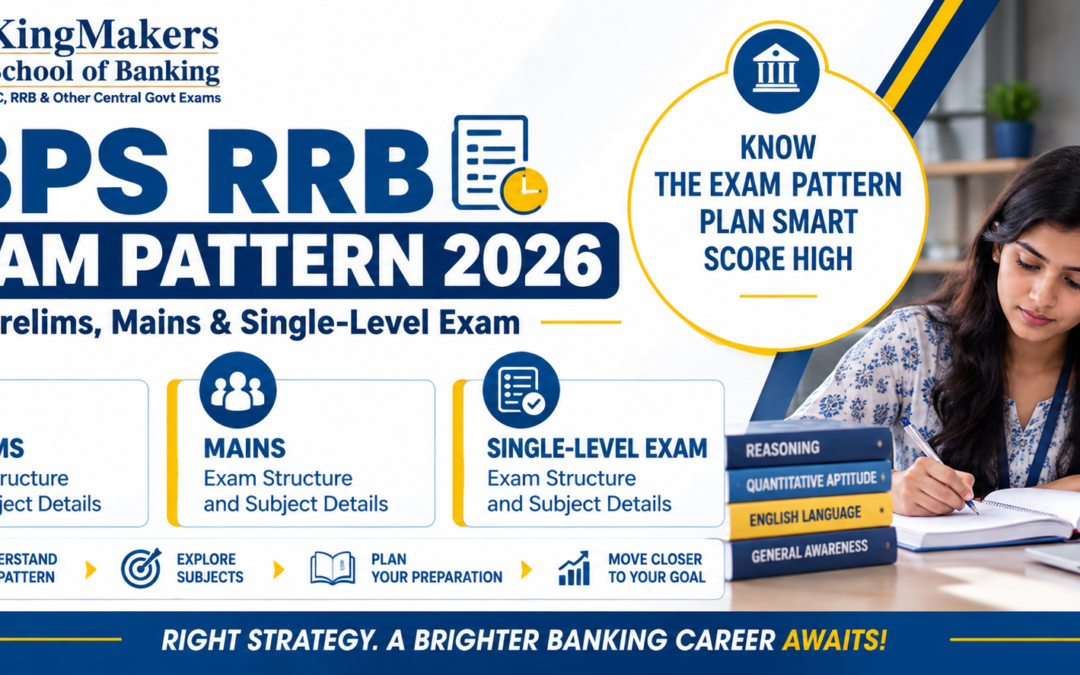
The IBPS RRB Exam Pattern 2026 is different for Office Assistant, Officer Scale I, Officer Scale II and Officer Scale III. Office Assistant and Scale I candidates appear for Prelims followed by Mains, while Scale II and Scale III candidates appear directly for a Single Level Examination. Officer posts also include an interview stage.
Before preparing, check your post-wise number of questions, marks, sectional timings, language options, negative marking and the stage that contributes to final selection. This guide explains the complete IBPS RRB 2026 exam pattern based on the latest IBPS RRB Notification.
Official source: The exam pattern below is based on the latest CRP-RRBs-XV notification issued by IBPS. Candidates should check the official notification and subsequent corrigenda for any changes to the examination structure or schedule.
IBPS RRB Exam Pattern 2026 at a Glance
The easiest way to understand the IBPS RRB pattern is to first look at how the examination is divided among the different posts.
Post | Exam Stages | Questions | Marks | Interview |
Office Assistant (Multipurpose) | Prelims + Mains | 80 + 200 | 80 + 200 | No |
Officer Scale I | Prelims + Mains | 80 + 200 | 80 + 200 | Yes |
Officer Scale II – General Banking Officer | Single Level | 200 | 200 | Yes |
Officer Scale II – Specialist Cadre | Single Level | 240 | 200 | Yes |
Officer Scale III | Single Level | 200 | 200 | Yes |
For Office Assistant and Officer Scale I, the Prelims examination is used to shortlist candidates for Mains. Prelims marks are not added to the final merit score.
For Officer posts, candidates who clear the required stages move towards the interview. The final selection for officer posts is based on the prescribed combination of online examination and interview marks.
IBPS RRB Selection Process
The selection process depends on the post you choose.
Office Assistant (Multipurpose)
Prelims → Mains → Provisional Allotment
There is no interview for the Office Assistant post. The Prelims examination is qualifying, while the Mains examination plays the deciding role in final merit.
Officer Scale I
Prelims → Mains → Common Interview → Provisional Allotment
Candidates first have to qualify in Prelims and then clear Mains to become eligible for the interview stage.
Officer Scale II and Scale III
Single Level Examination → Common Interview → Provisional Allotment
There is no separate Prelims examination for these posts.
IBPS RRB Office Assistant (Clerk) Exam Pattern
Prelims
The Office Assistant Prelims examination consists of two sections: Reasoning and Numerical Ability.
Section | Questions | Marks | Time |
Reasoning | 40 | 40 | 25 minutes |
Numerical Ability | 40 | 40 | 20 minutes |
Total | 80 | 80 | 45 minutes |
The paper has 80 questions carrying 80 marks, and candidates get a total of 45 minutes.
The time is divided between the two sections, so you cannot spend the entire exam time on one section. Building speed while practising sectional tests is therefore important.
Mains
The Office Assistant Mains examination is considerably broader than Prelims. Along with Reasoning and Numerical Ability, candidates also face Computer Knowledge, General Awareness and a language section.
Section | Questions | Marks | Time |
Reasoning | 40 | 50 | 30 minutes |
Computer Knowledge | 40 | 20 | 15 minutes |
General Awareness | 40 | 40 | 15 minutes |
English / Hindi Language | 40 | 40 | 30 minutes |
Numerical Ability | 40 | 50 | 30 minutes |
Total | 200 | 200 | 120 minutes |
Candidates choose either English or Hindi Language for the language section.
Since the Mains paper contains five sections and has sectional timings, preparation should not be limited to just Reasoning and Numerical Ability. General Awareness and Computer Knowledge also need regular revision.
IBPS RRB Officer Scale I (PO) Exam Pattern
Prelims
The Officer Scale I Prelims pattern is also divided into two sections.
Section | Questions | Marks | Time |
Reasoning | 40 | 40 | 25 minutes |
Quantitative Aptitude | 40 | 40 | 20 minutes |
Total | 80 | 80 | 45 minutes |
The Prelims examination contains 80 questions for 80 marks.
Candidates must qualify in both tests by securing the prescribed minimum cut-off marks. Candidates meeting the required criteria are shortlisted for the Mains examination.
Mains
The Officer Scale I Mains examination follows a similar structure.
Section | Questions | Marks | Time |
Reasoning | 40 | 50 | 30 minutes |
Computer Knowledge | 40 | 20 | 15 minutes |
General Awareness | 40 | 40 | 15 minutes |
English / Hindi Language | 40 | 40 | 30 minutes |
Quantitative Aptitude | 40 | 50 | 30 minutes |
Total | 200 | 200 | 120 minutes |
The total paper consists of 200 questions for 200 marks, with a total duration of 120 minutes.
You can choose either English or Hindi Language for the language test. Both languages are not attempted together.
IBPS RRB Officer Scale II Exam Pattern
General Banking Officer
Officer Scale II General Banking Officer candidates appear for a Single Level Examination. There is no separate Prelims stage.
Section | Questions | Marks | Time |
Reasoning | 40 | 50 | 30 minutes |
Computer Knowledge | 40 | 20 | 15 minutes |
Financial Awareness | 40 | 40 | 15 minutes |
English / Hindi Language | 40 | 40 | 30 minutes |
Quantitative Aptitude & Data Interpretation | 40 | 50 | 30 minutes |
Total | 200 | 200 | 120 minutes |
The exam has 200 questions carrying 200 marks, and candidates get 120 minutes to complete it.
Specialist Cadre
The Specialist Cadre paper is different from the General Banking Officer pattern. The major difference is the inclusion of Professional Knowledge.
Section | Questions | Marks | Time |
Professional Knowledge | 40 | 40 | 30 minutes |
Reasoning | 40 | 40 | 30 minutes |
Financial Awareness | 40 | 40 | 15 minutes |
English / Hindi Language | 40 | 20 | 30 minutes |
Computer Knowledge | 40 | 20 | 15 minutes |
Quantitative Aptitude & Data Interpretation | 40 | 40 | 30 minutes |
Total | 240 | 200 | 150 minutes |
There are 240 questions, but the paper carries a maximum of 200 marks.
If you are applying for a Specialist Officer post, Professional Knowledge deserves special attention because it is a dedicated section of the examination.
IBPS RRB Officer Scale III Exam Pattern
Officer Scale III candidates also appear for a Single Level Examination.
Section | Questions | Marks | Time |
Reasoning | 40 | 50 | 30 minutes |
Computer Knowledge | 40 | 20 | 15 minutes |
Financial Awareness | 40 | 40 | 15 minutes |
English / Hindi Language | 40 | 40 | 30 minutes |
Quantitative Aptitude & Data Interpretation | 40 | 50 | 30 minutes |
Total | 200 | 200 | 120 minutes |
The paper contains 200 questions for 200 marks, with a total exam duration of 120 minutes.
IBPS RRB Exam Medium and Language Options
For IBPS RRB Office Assistant (Multipurpose) and Officer Scale I, candidates can select the applicable Version of Test (Medium of Examination) based on the State/UT for which they are applying. The available languages vary from one State/UT to another. Candidates should select their preferred medium carefully while completing the online application.
State-Wise IBPS RRB Exam Medium
State/UT | Available Version of Test |
Andhra Pradesh | English, Hindi and Telugu |
Arunachal Pradesh | English and Hindi |
Assam | English, Hindi and Assamese |
Bihar | English and Hindi |
Chhattisgarh | English and Hindi |
Gujarat | English, Hindi and Gujarati |
Haryana | English and Hindi |
Himachal Pradesh | English and Hindi |
Jammu & Kashmir | English, Hindi and Urdu |
Jharkhand | English and Hindi |
Karnataka | English, Hindi, Kannada and Konkani |
Kerala | English, Hindi and Malayalam |
Madhya Pradesh | English and Hindi |
Maharashtra | English, Hindi, Marathi and Konkani |
Manipur | English, Hindi and Manipuri |
Meghalaya | English and Hindi |
Mizoram | English and Hindi |
Nagaland | English and Hindi |
Odisha | English, Hindi and Odia |
Puducherry | English, Hindi, Tamil, Telugu and Malayalam |
Punjab | English, Hindi and Punjabi |
Rajasthan | English and Hindi |
Tamil Nadu | English, Hindi and Tamil |
Telangana | English, Hindi, Telugu and Urdu |
Tripura | English, Hindi and Bengali |
Uttar Pradesh | English, Hindi and Urdu |
Uttarakhand | English and Hindi |
West Bengal | English, Hindi and Bengali |
The official IBPS information handout specifies these State/UT-wise test versions for Office Assistant and Officer Scale I.
Important Note on the Language Section
The Language section in the Office Assistant and Officer Scale I examinations is different from the overall medium of the examination. Candidates choose English or Hindi for this section. The other tests are available in English and the applicable State/UT language(s) specified by IBPS.
For example, candidates applying in Tamil Nadu can select Tamil as an applicable test medium, along with English and Hindi. Candidates applying in Puducherry can select English, Hindi, Tamil, Telugu or Malayalam.
Candidates should check the latest IBPS RRB notification and information handout before applying, as IBPS may revise the available test versions or other examination details.
IBPS RRB Negative Marking
IBPS RRB follows a negative marking system in the online examinations.
For every incorrect answer, one-fourth of the marks assigned to that question is deducted. In a section where each question carries one mark, this means a deduction of 0.25 marks for a wrong answer.
There is no negative marking for an unanswered question.
For example, if you attempt 30 questions and get 24 correct and 6 wrong:
- Correct answers: 24 × 1 = 24 marks
- Wrong answers: 6 × 0.25 = 1.5 marks deducted
- Net score: 22.5 marks
Candidates should avoid blind guessing because an incorrect answer attracts a penalty, while an unanswered question carries no penalty.
IBPS RRB Scoring and Normalization
If the examination is conducted in different sessions, the corrected scores are normalised using the equi-percentile method. Scores up to two decimal places are considered for calculation.
For final selection, the importance of the examination score depends on the post:
- Office Assistant: Mains marks are considered for final merit.
- Officer Scale I: Mains marks are considered for interview shortlisting and final merit.
- Officer Scale II and III: Single Level Examination marks are considered for interview shortlisting and final merit.
IBPS RRB Cut-Off and Shortlisting
Candidates must meet the prescribed minimum score requirements in the applicable tests to qualify for the next stage. For Office Assistant and Officer Scale I, candidates must qualify in the required Prelims tests to be shortlisted for Mains. For Officer Scale II and III, candidates must meet the prescribed requirements in the Single Level Examination for interview shortlisting.
Meeting the minimum cut-off alone does not guarantee selection. Candidates are shortlisted according to the applicable merit and vacancies.
IBPS RRB Interview Pattern
The interview applies to Officer Scale I, Scale II and Scale III posts. Office Assistant candidates do not have an interview.
The interview carries 100 marks.
The prescribed qualifying requirement is:
- 40% for general candidates
- 35% for SC/ST/OBC/PwBD candidates
For Officer Scale I, II and III, the online examination and interview carry relative weightage in the ratio of 80:20 for the final score.
Candidates who are selected for the interview should be prepared with questions on banking & financial awareness, current affairs, educational/professional background and Regional Rural Banking sector.
Common Mistakes to Avoid in IBPS RRB Preparation
Knowing the pattern is useful only when you actually use it to plan your preparation. Avoid these common mistakes:
- Preparing for every post in the same way: Office Assistant and Officer Scale I have Prelims, while Scale II and III do not.
- Ignoring sectional timing: Finishing the paper within the total duration is not enough; you have to manage each section within its allotted time.
- Focusing only on the overall score: Section-wise performance matters too.
- Overlooking the Specialist Cadre pattern: Scale II Specialist candidates have a Professional Knowledge section and a different question distribution.
- Leaving awareness preparation for the end: General and Financial Awareness require regular revision.
- Guessing too many answers: Negative marking can quickly reduce your score.
- Ignoring the interview: For officer posts, the interview contributes to the final score.
How to Prepare According to Your Post
Your preparation strategy should match the post you are targeting.
If you are preparing for Office Assistant or Officer Scale I, give special attention to Reasoning and Numerical Ability/Quantitative Aptitude during Prelims because these two sections make up the entire Prelims paper.
Once you move towards Mains, expand your preparation to include General Awareness, Computer Knowledge and the language section.
For Officer Scale II and III, there are no Prelims to act as a separate screening stage. You need to prepare for the complete Single Level Examination from the beginning.
Specialist Cadre candidates should give consistent time to Professional Knowledge instead of trying to cover it at the last minute.
Most importantly, practise mocks according to the actual pattern of your target post. Do not practise only full-length tests. Sectional tests are equally useful because they help you get comfortable with the individual time limits.
Final Takeaway
Understand the IBPS RRB 2026 exam pattern as per the post you are targeting. Candidates for Office Assistant and Officer Scale I have to appear for Prelims and then Mains while candidates for Officer Scale II and III appear for Single Level Examination. Officers are interviewed as part of the process.
Before you begin your preparation, note the sections, marks, timings, test medium and selection stages applicable to your post. Always refer to the latest IBPS notification and Information Handout for any changes thereafter.
Start Your IBPS RRB Preparation 2026
With the IBPS RRB CRP-RRBs-XV recruitment process underway, candidates should organise their preparation around the exact post they are targeting. Check the latest notification for important dates, understand your exam pattern, practise according to the sectional timings and keep your General/Financial Awareness preparation consistent.