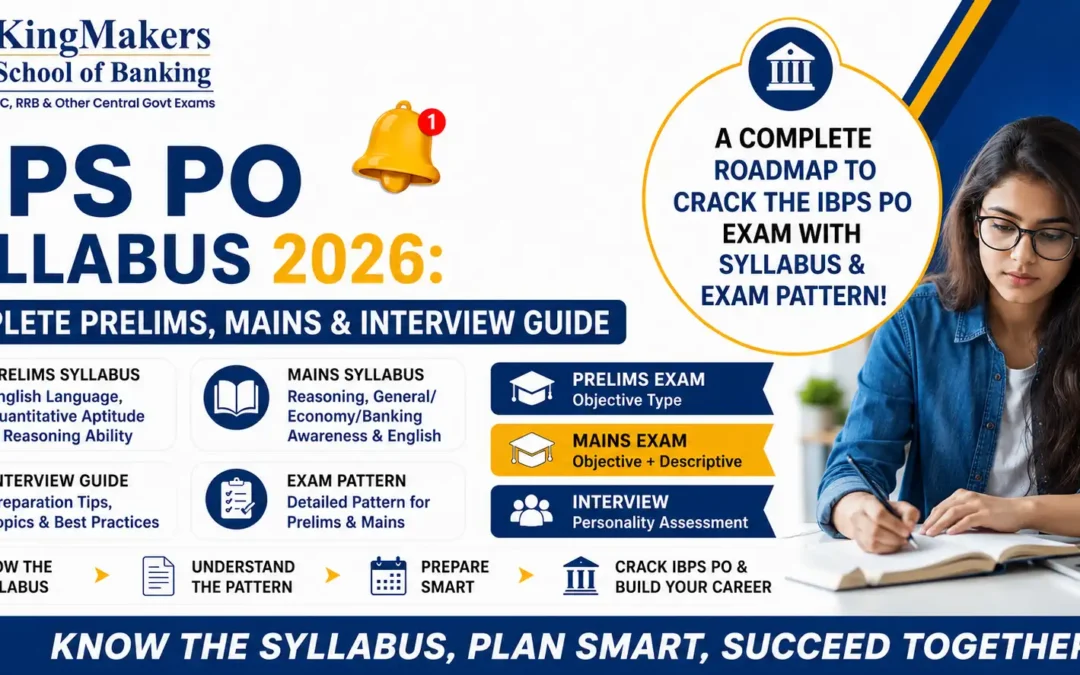
Every year around this time, the same question floods bank-exam forums: “Is the syllabus still the same, or did IBPS change something again?” This year, it actually did.The IBPS PO (CRP PO/MT-XVI) notification came with a revised Mains pattern, and if you’re preparing with last year’s structure, you’re already a step behind without realizing it.
This guide lays out the complete IBPS PO Syllabus 2026 the exam pattern for Prelims and Mains, section-wise topics in a quick-reference format, and the full selection process through to the interview. No Stuffed, no recycled PDF text just what you need to build an actual study plan around.
IBPS PO Selection Process 2026
BPS PO recruitment (CRP PO/MT-XVI) runs across four stages, and you need to clear each one to move to the next:
- Prelims – A qualifying screening round; marks here don’t count toward your final merit
- Mains – the stage that actually decides your score
- Personality Test – a mandatory, qualifying-only round conducted before the interview
- Interview – conducted by the participating bank, coordinated through the nodal bank in each state
Here’s the part candidates often miss: your final merit list is built purely from Mains + Interview marks, combined in an 80:20 ratio. Prelims only decides whether you get a shot at Mains, nothing more, nothing less.
Quick reality check: IBPS PO 2026 notification (released 30th June 2026) has announced 6,715 vacancies, with online applications open from 1st to 21st July 2026. Competition will be steep, so treat every stage as equally important rather than coasting through Prelims.
IBPS PO Exam Pattern 2026 (Prelims + Mains + Interview)
Prelims Pattern
The Preliminary exam pattern hasn’t changed this year, only the internal marks split has shifted slightly.
| Section | Questions | Marks | Duration |
|---|---|---|---|
| English Language | 30 | 30 | 20 minutes |
| Reasoning Ability | 35 | 40 | 20 minutes |
| Quantitative Aptitude | 35 | 30 | 20 minutes |
| Total | 100 | 100 | 60 minutes |
Reasoning now carries 40 marks (up from 35), while Quant has dropped to 30. English stays at 30. Each section has its own 20-minute timer, so you can’t borrow time from one to rescue another.
Negative marking applies: 0.25 marks deducted per wrong answer, nothing deducted for skipped questions.
Mains Pattern (Revised for 2026)
This is where the real change happened. IBPS increased the objective question count from 145 to 170, without changing the total objective marks (200) or the overall duration.
| Reasoning Ability | Questions | Marks | Duration |
|---|---|---|---|
| Reasoning Ability | 40 | 60 | 45 minutes |
| General/Economy/Banking/Digital Awareness | — | 60 | 35 minutes |
| Data Analysis & Interpretation | — | 60 | 45 minutes |
| English Language | 40 | 20 | 35 minutes |
| Objective Total | 170 | 200 | 160 minutes |
| Descriptive Test (Essay + Comprehension) | 2 | 25 | 35 minutes |
| Grand Total | 172 | 225 | 190 minutes |
A few things worth flagging:
- Reasoning, Awareness, and DI now carry equal weight 60 marks each making up 180 of the 200 objective marks.
- Letter writing has been dropped from the descriptive paper. It’s now Essay + Comprehension only.
- Awareness now explicitly includes RBI circulars and digital/financial awareness, not just static GK.
- Same negative marking rule applies: -0.25 per wrong objective answer.
Note: The detailed section-wise marks distribution, revised Mains pattern, negative marking, and descriptive paper are explained in our dedicated IBPS PO Exam Pattern 2026 guide.
Interview & Personality Test
Candidates who clear Mains move to a mandatory Personality Test (qualifying only, no marks added) followed by the Interview, worth 100 marks. Minimum qualifying marks: 40% (35% for SC/ST/OBC/PWBD candidates).
IBPS PO Prelims Syllabus (Detailed Breakdown)
| English Language | Reasoning Ability | Quantitative Aptitude |
|---|---|---|
| Reading Comprehension (inference-based) | Seating Arrangement (circular, linear, box-based) | Simplification and Approximation |
Cloze Test | Puzzles (multi-variable) | Number Series |
| Para Jumbles | Inequality (direct and coded) | Quadratic Equations |
Error Detection / Sentence Correction | Syllogism | Data Interpretation (bar, table, pie, line) |
| Fill in the Blanks (single/double) | Blood Relations | Percentages, Ratio & Proportion, Averages |
Word usage and contextual vocabulary | Direction Sense | Profit & Loss, SI & CI |
| — | Alphanumeric Series and Coding-Decoding | Time, Speed & Distance; Time & Work |
| — | Data Sufficiency (occasional) | Mensuration and Mixtures & Alligations |
IBPS PO Mains Syllabus (Section-Wise Topics)
| Reasoning Ability | Data Analysis & Interpretation | Awareness (General/Economy/Banking/Digital) | English Language | Descriptive Test |
|---|---|---|---|---|
| Higher-difficulty puzzles: floor-based, scheduling, multi-variable seating | Table, Bar, Pie, Line, Caselet-based DI | Current banking/financial news (last 6 months) | Reading Comprehension (higher difficulty, inference) | Essay Writing (banking, economy, tech, social issues, environment) |
| Syllogism with complex statements | Missing Data Interpretation | RBI monetary policy, repo rate, circulars | Sentence Rearrangement and Error Spotting | Comprehension-based response writing |
| Input-Output (coded formats) | Probability and Permutation & Combination | Government schemes (banking/finance) | Vocabulary in business/banking context | — |
| Data Sufficiency | Data Sufficiency (numerical) | Union Budget and Economic Survey highlights | Grammar-based fill-ins and paragraph completion | — |
| Logical Reasoning (statement-conclusion, course of action) | Ratio/proportion-based case studies | Banking terminology, history, reforms | — | — |
| Coding-Decoding (mixed formats) | — | Digital banking (UPI, CBDC, fintech regulations) | — | — |
| — | — | Static GK: abbreviations, HQs, apex institutions | — | — |
IBPS PO Interview Process
Once you clear Mains, you’ll go through:
- Personality Test – assesses communication, temperament, and suitability for an officer role; qualifying in nature, doesn’t add marks
- Interview – conducted by a panel from the participating bank, coordinated by the nodal bank for your state
Common areas covered in the interview:
- Your academic and professional background
- Awareness of banking sector developments and the bank you’re applying to
- Situational and HR-style questions to gauge decision-making
- Basic questions on your work experience or specialization, if applicable
Since final merit combines Mains and Interview scores in an 80:20 ratio, a strong Mains score gives you a real cushion but don’t walk into the interview underprepared just because the weightage looks small. A poor interview can still undo a good Mains performance.
Preparation Strategy & Exam Tips
- Don’t over-invest in Prelims. It’s purely qualifying, clear the cutoff comfortably and shift your focus to Mains-level prep early instead of chasing a high Prelims score.
- Respect the sectional timers. Each Prelims section has its own 20-minute clock, so practice sectional mocks, not just full-length ones you can’t borrow time across sections.
- Prioritize Puzzles and DI in Prelims. Together they account for nearly 40-45% of Prelims marks across sections, more than any other topic cluster.
- Adjust your speed for the new Mains pattern. 170 questions now fit into the same 160 minutes that used to cover 145 start timing DI and Reasoning sets in 8-10 minute blocks instead of solving them leisurely.
- Treat Awareness as your fastest scoring section in Mains. It carries 60 marks with zero calculation involved. Spending 15-20 minutes daily on banking current affairs rather than cramming in the last two weeks doesn’t stick that way.
- Practice Essay and Comprehension writing weekly, not daily 2-3 timed writing sessions a week are enough to stay sharp for the revised descriptive format.
- Don’t underprepare for the interview just because it carries less weightage than Mains. It can still swing your final rank either way.
- Run weekly full-length mocks once your syllabus coverage is underway, and always review your wrong answers before moving to the next topic repeating the same mistake in every mock is the most common reason scores plateau.
Frequently Asked Questions
It covers English Language, Quantitative Aptitude, and Reasoning Ability 100 questions for 100 marks, with 20 minutes allotted per section.
Yes. Objective questions increased from 145 to 170, though total marks (200) and duration (160 minutes) stayed the same. Letter writing has been removed from the descriptive paper, leaving only Essay and Comprehension.
Prelims (qualifying), Mains, a mandatory Personality Test, and an Interview. Final merit is based only on Mains and Interview marks, combined in an 80:20 ratio.
Reasoning, Awareness, and Data Analysis & Interpretation each carry 60 marks, the three highest-weighted objective sections.
Yes, 0.25 marks are deducted for every wrong answer in both Prelims and Mains objective sections. No marks are deducted for unattempted questions.
40% overall, relaxed to 35% for SC/ST/OBC/PWBD candidates.
No. Prelims is purely qualifying only Mains and Interview scores decide your final rank.
Ready to Start Preparing?
The IBPS PO Exam Pattern 2026 isn’t drastically different from previous years, but the Mains revision has more questions, same time, a reshuffled Awareness section, and a new descriptive format means your old strategy needs a few real adjustments, not just a syllabus glance. Map out a weekly plan today: start with Prelims fundamentals, layer in Mains-level DI and Awareness as you go, and get into the habit of full-length mocks at least once a week. The syllabus is the same for everyone appearing this year how you use your preparation time is what will actually separate you from the crowd.