A career in banking continues to be one of the most seeking options among fresh graduates in India. With attractive salaries, job security, growth opportunities, bank jobs remain a preferred choice for lakhs of aspirants every year.
But how can freshers secure a bank job in 2026? What will be the Eligibility Criteria ? Which exam should you prepare for? Is coaching necessary? These questions often confuse beginners.
This comprehensive guide will help you understand the eligibility criteria, exam pattern, preparation strategy, and everything you need to know to start your banking career successfully.
Bank Exam Eligibility Criteria 2026-27
Educational Qualification
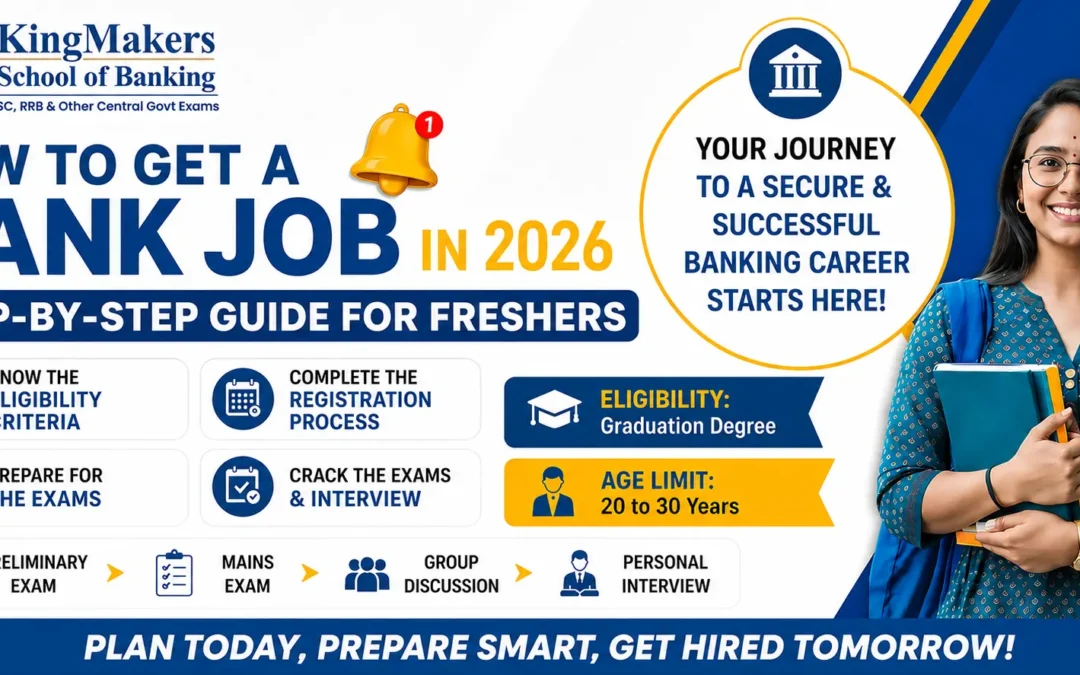
Candidates must have a bachelor’s degree in any discipline from a recognized university. Final-year students can also apply, provided they submit proof of graduation before document verification. Some exams may additionally require basic computer knowledge or proficiency in the local language.Age Limit Criteria
Candidates applying for bank exams must satisfy the prescribed age criteria specified in the official notification. For most examinations such as IBPS PO and SBI PO, the minimum age required is 20 years, while the maximum age is 30 years. Age is calculated as on the cut-off date mentioned by the conducting authority.| Category | Minimum Age | Maximum Age Limit | Age Relaxation |
|---|---|---|---|
| General/EWS | 20 Years | 30 Years | No Relaxation |
| OBC (Non-Creamy Layer) | 20 Years | 33 Years | 3 Years |
| SC/ST | 20 Years | 35 Years | 5 Years |
| PwBD (General/EWS) | 20 Years | 40 Years | 10 Years |
| PwBD (OBC) | 20 Years | 43 Years | 13 Years |
| PwBD (SC/ST) | 20 Years | 45 Years | 15 Years |
| Ex-Servicemen | 20 Years | As per Government Norms | 5 Years |
| Widows/Divorced Women (General) | 20 Years | 35 Years | 5 Years |
| Widows/Divorced Women (SC/ST) | 20 Years | 40 Years | 10 Years |
Candidates should note that the upper age limit and relaxation criteria may vary slightly depending on the examination, such as IBPS Clerk, SBI Clerk, RRB Officer Scale-I, or RBI Grade B. Therefore, applicants are advised to verify the latest eligibility conditions mentioned in the official notification before submitting their application.
Nationality
The following candidates are eligible to apply:
- Citizens of India.
- Subjects of Nepal or Bhutan.
- Tibetan refugees who settled in India before January 1, 1962.
- Persons of Indian Origin who migrated from specified countries with the intention of permanently settling in India.
Candidates belonging to categories other than Indian citizens may be required to produce an eligibility certificate issued by the Government of India.
Before submitting the application, candidates should carefully verify the eligibility conditions mentioned in the official notification to avoid disqualification during the selection process.
Understanding the Bank Exams
Various banking organizations conduct recruitment exams every year. The most common ones are:
IBPS Exams
The Institute of Banking Personnel Selection (IBPS) conducts several examinations for recruitment to public sector banks and regional rural banks.
IBPS PO (Probationary Officer)
IBPS PO is one of the most sought-after banking exams for graduates. Selected candidates are appointed as Probationary Officers in participating public sector banks and undergo training before taking up managerial responsibilities.
IBPS Clerk
IBPS Clerk recruits candidates for clerical positions in public sector banks. The role primarily involves customer service, account handling, and day-to-day banking operations.
IBPS SO (Specialist Officer)
IBPS SO is conducted for candidates with specialized qualifications. It offers posts such as:
- IT Officer
- Agriculture Field Officer
- Marketing Officer
- HR Officer
- Law Officer
- Rajbhasha Adhikari
IBPS RRB Officer Scale-I (PO)
Also known as IBPS RRB PO, this examination recruits Officer Scale-I personnel for Regional Rural Banks. Selected candidates perform managerial and administrative duties in rural banking institutions.
IBPS RRB Office Assistant (Clerk)
IBPS RRB Clerk recruits candidates for Office Assistant positions in Regional Rural Banks. The job mainly focuses on customer support, cash handling, and routine banking services.
SBI Exams
State Bank of India conducts its own recruitment examinations and offers attractive salary packages and career opportunities.
SBI PO (Probationary Officer)
SBI PO is one of the most prestigious banking examinations in India. Selected candidates are appointed as officers and receive extensive training, attractive salaries, and additional benefits.
SBI Clerk (Junior Associate)
SBI Clerk recruits candidates for customer support and clerical operations. Junior Associates are responsible for handling transactions, assisting customers, and maintaining banking records.
RBI Exams
The Reserve Bank of India conducts examinations for various administrative and officer-level positions.
RBI Assistant
RBI Assistant is a highly competitive examination for clerical positions in the Reserve Bank of India. Employees are responsible for maintaining records, customer service, and supporting the bank’s daily operations.
RBI Grade B
RBI Grade B is one of the most prestigious examinations in the banking and financial sector. Officers recruited through this exam work in areas such as monetary policy, banking regulation, currency management, and economic research.
Other Banking and Insurance Exams
Apart from IBPS, SBI, and RBI, several organizations conduct recruitment examinations for officer-level positions.
NABARD Grade A
The National Bank for Agriculture and Rural Development (NABARD) conducts Grade A examinations for Assistant Manager posts. Officers play an important role in rural development, agricultural financing, and policy implementation.
LIC AAO (Assistant Administrative Officer)
Life Insurance Corporation of India recruits Assistant Administrative Officers through the LIC AAO examination. The role involves policy administration, claim settlement, and customer relationship management.
NIACL AO (Administrative Officer)
The New India Assurance Company Limited conducts the NIACL AO examination to recruit Administrative Officers. Selected candidates handle insurance operations, underwriting, claims processing, and customer services.
Each exam has different eligibility criteria and selection procedures, but the syllabus remains largely similar.
Exam Pattern and Syllabus
Understanding the exam pattern and syllabus is one of the most important steps in bank exam preparation. Most banking examinations such as IBPS PO, IBPS Clerk, SBI PO, SBI Clerk, and RRB exams follow a three-stage selection process consisting of Preliminary Examination, Main Examination, and Interview (for officer-level posts).
Preliminary Examination Pattern
The Preliminary Exam is qualifying in nature and acts as the first stage of selection. Candidates must clear sectional as well as overall cut-offs.
| Section | No. of Questions | Maximum Marks | Time Allotted |
|---|---|---|---|
| English Language | 30 | 30 | 20 Minutes |
| Quantitative Aptitude | 35 | 35 | 20 Minutes |
| Reasoning Ability | 35 | 35 | 20 Minutes |
| Total | 100 | 100 | 60 Minutes |
Important Points to remember
- Individual time limits are allotted for each section.
- Every incorrect answer attracts a penalty of 0.25 marks.
- Prelims marks are generally not considered for the final selection in PO and Clerk examinations.
- Speed and accuracy play a major role in clearing the cut-off.
Preliminary Exam Syllabus
| Subject | Topics |
|---|---|
| English Language | Reading Comprehension, Cloze Test, Error Detection, Fill in the Blanks, Sentence Rearrangement, Para Jumbles, Phrase Replacement, Word Swap, Vocabulary, Idioms and Phrases |
| Quantitative Aptitude | Simplification and Approximation, Number Series, Quadratic Equations, Percentage, Ratio and Proportion, Profit and Loss, Average, Simple and Compound Interest, Time and Work, Pipes and Cisterns, Speed, Time and Distance, Partnership, Probability, Permutation and Combination, Data Interpretation, Data Sufficiency |
| Reasoning Ability | Puzzles, Seating Arrangement, Syllogism, Coding-Decoding, Blood Relations, Direction Sense, Inequality, Order and Ranking, Alpha-Numeric Series, Input-Output, Logical Reasoning, Statement and Assumption |
Main Examination Pattern
The Main Examination is the most crucial stage as marks obtained here are considered for final selection
| Section | Questions | Marks | Time |
|---|---|---|---|
| Reasoning & Computer Aptitude | 45 | 60 | 60 Minutes |
| General/Economy/Banking Awareness | 40 | 40 | 35 Minutes |
| English Language | 35 | 40 | 40 Minutes |
| Data Analysis & Interpretation | 35 | 40 | 40 Minutes |
| Total Objective Test | 155 | 200 | 180 Minutes |
| Descriptive Test (Essay & Letter Writing) | 2 | 25 | 30 Minutes |
Main Examination Syllabus
| Subject | Topics |
|---|---|
| Reasoning Ability & Computer Aptitude | High-Level Puzzles, Seating Arrangement, Input-Output, Logical Reasoning, Data Sufficiency, Coding-Decoding, Statement and Conclusion, Cause and Effect, Syllogism, Blood Relations. Computer Fundamentals, MS Office, Internet and Networking, Operating Systems, Memory Devices, Hardware, Software Concepts, Cyber Security. |
| Data Analysis & Interpretation | Caselet DI, Bar Graph, Pie Chart, Line Graph, Missing DI, Probability, Permutation and Combination, Quantity Comparison, Data Sufficiency, Percentage, Profit and Loss, Time and Work, Speed, Time and Distance, Ratio and Proportion, Partnership, Mixtures and Allegations, Ages, Simple and Compound Interest. |
| English Language | Reading Comprehension, Cloze Test, Error Spotting, Fillers, Sentence Improvement, Para Jumbles, Match the Column, Vocabulary, Phrase Replacement, Word Usage. |
| General Awareness & Banking Awareness | National and International News, Awards, Sports, Govt Schemes, RBI Functions, Monetary Policy, Repo Rates, Basel Norms, Digital Banking (NEFT/RTGS/IMPS), Banking Terminologies, Static GK (Capitals, National Parks, Rivers, Indian Economy Basics). |
Descriptive Test Syllabus
Applicable mainly for SBI PO and IBPS PO.
| Section | Marks |
|---|---|
| Essay Writing | 15 |
| Letter Writing | 10 |
| Total | 25 |
Topics Asked
- Digital Banking
- Financial Inclusion
- Artificial Intelligence
- Cyber Security
- Economy and Budget
- Climate Change
- Education and Employment
- Formal and Informal Letter Writing
Interview Round in Bank Exams: Complete Guide for IBPS PO, SBI PO, RBI Grade B, and NABARD Exams
The interview stage is conducted for officer-level positions such as:
- IBPS PO
- SBI PO
- RBI Grade B
- NABARD Grade A
Important Topics Asked in Bank Exam Interviews
The interview round is the final stage for officer-level banking examinations such as IBPS PO, SBI PO, RBI Grade B, and NABARD Grade A. Apart from testing your knowledge, the interview panel evaluates your communication skills, confidence, personality, and suitability for a career in banking. Here are the most important areas candidates should prepare thoroughly.
Self Introduction
Almost every bank interview begins with the question, “Tell me about yourself.” Candidates should prepare a brief and professional introduction covering:
- Educational background
- Hometown and family details
- Academic achievements
- Work experience (if any)
- Career goals and interest in banking
A clear and confident introduction creates a positive first impression and sets the tone for the rest of the interview.
Banking Awareness
Interviewers frequently assess a candidate’s understanding of the banking sector and financial system. Questions are usually asked about:
- Functions of RBI
- Monetary policy and repo rate
- Types of bank accounts
- Digital banking services
- NEFT, RTGS, IMPS, and UPI
- Priority sector lending
- Financial inclusion schemes
- Public and private sector banks
Candidates should stay updated with recent developments in the banking industry to answer confidently.
Graduation Subject
Candidates are often asked questions related to their educational background. Interviewers may test fundamental concepts from the subject studied during graduation. For example:
- Commerce students may face questions on accounting and economics.
- Engineering graduates may be asked about core technical concepts.
- Science graduates may be questioned on basic principles from their discipline.
A sound understanding of your academic subject demonstrates consistency and conceptual clarity.
Strengths and Weaknesses
This section helps interviewers understand your personality and self-awareness. Candidates should:
- Highlight strengths that are relevant to banking, such as leadership, communication skills, adaptability, and problem-solving abilities.
- Mention weaknesses honestly while explaining how they are being improved.
Avoid giving answers that may create a negative impression or suggest a lack of responsibility.
Why Banking?
One of the most common questions in bank interviews is why you want to join the banking sector. Candidates should explain:
- Interest in the financial industry
- Long-term career opportunities in banking
- Job stability and professional growth
- Desire to contribute to economic development
- Opportunities to interact with customers and solve financial problems
If you want a clear overview on choosing Banking check the Video posted by Kingmakers School of Banking.
Situation-Based Questions
Many interviewers ask hypothetical questions to assess analytical thinking and decision-making skills. Examples include:
- How would you handle an angry customer?
- What would you do if you discovered an error in a customer’s account?
- How would you prioritize multiple tasks under pressure?
- How would you respond to ethical dilemmas in the workplace?
These questions test your problem-solving ability, customer service attitude, and professional ethics.
Step-by-Step Guide For Cracking Bank Exams
Step 1: Choose the Right Bank Exam
Selecting the right bank exam is the foundation of your preparation. Every banking examination has different responsibilities, difficulty levels, and career growth opportunities. Choosing an exam that aligns with your educational qualification, age, and long-term career goals will make your preparation more focused and effective.
For Beginners
IBPS Clerk
IBPS Clerk is one of the most popular entry-level bank exams in India. It is ideal for freshers who want to start their banking career without facing an interview stage. The selection process consists of Preliminary and Main examinations, making it a good starting point for beginners.
SBI Clerk
SBI Clerk offers the opportunity to work with the country’s largest public sector bank. The exam pattern is similar to IBPS Clerk, and candidates receive attractive salary packages along with excellent promotion opportunities. It is considered one of the best options for first-time aspirants.
For Officer-Level Positions
IBPS PO
IBPS Probationary Officer is suitable for candidates aspiring to become bank officers. The recruitment process includes Preliminary Examination, Main Examination, and Interview. It offers excellent career growth and opportunities to reach managerial positions.
SBI PO
SBI PO is one of the most prestigious banking examinations in India. Officers recruited through SBI PO receive competitive salaries, extensive training, and fast-track promotions. The exam is slightly more competitive but offers outstanding career prospects.
For Rural Banking
IBPS RRB PO
The IBPS Regional Rural Bank (RRB) PO examination is designed for candidates interested in working in rural and semi-urban areas. It provides officer-level positions with good salaries and promotion opportunities while contributing to financial inclusion in rural India.
IBPS RRB Clerk
IBPS RRB Clerk is an excellent option for candidates seeking stable employment in regional rural banks. The exam pattern is relatively easier compared to other officer-level exams, making it suitable for beginners.
For Regulatory Bodies
RBI Assistant
RBI Assistant is conducted by the Reserve Bank of India and offers excellent work-life balance and attractive pay. Employees enjoy numerous benefits and opportunities to work in India’s central banking institution.
RBI Grade B
RBI Grade B is considered one of the most prestigious examinations in the banking and finance sector. It offers high salaries, faster career growth, and opportunities to work in policymaking and financial regulation. However, the exam requires a higher level of preparation compared to other banking exams.
Step 2: Create a Study Plan
Success in bank exams requires consistency.
Daily Study Schedule
| Subject | Time Allocation |
|---|---|
| Quantitative Aptitude | 2 Hours |
| Reasoning Ability | 2 Hours |
| English Language | 1 Hour |
| Current Affairs | 1 Hour |
| Revision and Mock Tests | 1 Hour |
90-Day Preparation Strategy
| Phase | Duration | Goal |
|---|---|---|
| Phase 1 | Days 1-30 | Build Concepts |
| Phase 2 | Days 31-60 | Practice Questions |
| Phase 3 | Days 61-90 | Mock Tests and Revision |
Step 3: Build Strong Fundamentals
A strong foundation is essential to crack bank exams.
| Subject | Important Topics |
|---|---|
| Quantitative Aptitude | Percentage, Ratio, Profit and Loss, Time and Work |
| Reasoning Ability | Puzzles, Coding-Decoding, Syllogism |
| English Language | Vocabulary, Grammar, Reading Comprehension |
| General Awareness | Banking Awareness and Current Affairs |
Strong fundamentals increase speed and accuracy during the exam
Step 3: Practice Mock Tests and Previous Papers
Mock tests are the backbone of bank exam preparation.
Benefits of Mock Tests
- Improve speed.
- Increase accuracy.
- Enhance time management.
- Build confidence.
Previous year papers help you understand:
- Exam difficulty level.
- Frequently asked topics.
- Question patterns.
Experts recommend attempting at least 50–70 full-length mock tests before the examination and every aspirant should be updated with current affairs because it helps to crack any type of questions .
Step 4: Apply for Exams and Attend Interviews
Clearing the written examination is only one part of the journey. Candidates must also complete the application process correctly and prepare effectively for the interview stage. A small mistake while filling out the application form or a lack of interview preparation can affect your chances of selection.
Application Process
1. Visit the Official Website
The first step is to regularly check the official websites of recruitment authorities such as:
- IBPS – www.ibps.in/index.php/careers/
- SBI Careers – sbi.bank.in/web/careers
- RBI Opportunities – opportunities.rbi.org.in/
- NABARD – www.nabard.org/ftrcontent.aspx?
- Keep track of notifications regarding vacancies, eligibility criteria, important dates, and examination schedules. Reading the official notification carefully helps avoid errors during the application process.
2. Register Online
After the notification is released:
- Click on the “New Registration” link.
- Enter your name, email ID, and mobile number.
- Generate a registration number and password.
- Save these details carefully for future use.
Make sure the information provided matches your educational certificates and identity documents.
3. Upload Documents
Candidates need to upload scanned copies of:
| Required Documents | Format |
|---|---|
| Passport-size Photograph | JPG/JPEG |
| Signature | JPG/JPEG |
| Left Thumb Impression | JPG/JPEG |
| Handwritten Declaration | JPG/JPEG |
| Identity Proof | PDF/JPG |
| Educational Certificates |
Ensure that the uploaded documents meet the specified dimensions and file sizes mentioned in the notification.
4. Pay the Application Fee
After completing the application form and uploading the required documents, candidates must pay the prescribed application fee to successfully submit their bank exam application. The fee amount varies depending on the candidate’s category and may differ slightly across examinations.
| Category | Approximate Fee |
|---|---|
| General/OBC/EWS | ₹850 |
| SC/ST/PwBD | ₹175 |
Candidates can make the payment through various online modes, including:
- Debit Card
- Credit Card
- Net Banking
- UPI
- Mobile Wallets
Once the payment is successfully processed, a confirmation message will be displayed. Candidates should download or save the payment receipt and application form for future reference. These documents may be required during admit card download, document verification, or any future correspondence related to the recruitment process.
Before making the payment, candidates should carefully verify all details entered in the application form, as the fee is generally non-refundable and non-transferable.
5. Download Admit Card
A few weeks before the examination:
- Visit the official website.
- Log in using your registration number and password.
- Download the admit card.
- Verify personal details and exam center information.
- Print multiple copies for safety.
Without the admit card and valid ID proof, candidates will not be allowed to appear for the examination.
Bank Salary Structure 2026: Salary, and Benefits
One of the biggest attractions of banking careers is the combination of good salary, job security, and excellent growth opportunities.
Salary Structure in Banking Sector
| Position | Approximate Monthly Salary |
|---|---|
| Clerk | ₹35,000–₹45,000 |
| Probationary Officer (PO) | ₹52,000–₹65,000 |
| RBI Assistant | ₹45,000–₹55,000 |
| RBI Grade B Officer | ₹80,000–₹1,10,000 |
Apart from the basic pay, employees receive several allowances and benefits.
Additional Benefits
- Dearness Allowance (DA)
- House Rent Allowance (HRA)
- Medical Benefits
- Newspaper Allowance
- Travel Allowance
- Leave Travel Concession (LTC)
- Pension Benefits
- Performance Incentives
These benefits significantly increase the overall compensation package.
Final Tips for Freshers
- Well-structured study plan: Developing a structured plan with clear daily and weekly goals, you can easily navigate through studies. It resolves the problem of near-exam anxiety and frustration or join a best bank coaching centre to crack bank exams even easier.
- Examine the syllabus well: Make sure to examine the syllabus and understand what kind of topics you need to study. Prioritize your weak spots and strengthen them.
- Build short notes: While studying, build a repository of notes which helps you to review them regularly and serves as a good preparation material before the exam.
- Review Previous year question papers: Reviewing the past year question papers can tell you what sort of questions you likely encounter in the examination. Also, practicing those question papers under the stipulated time can build exam time confidence.
- Do consistent revision: Revisiting the learned material can strengthen memory. Keep a schedule and review regularly to enhance your learning.
Conclusion
Getting a bank job in 2026 is achievable for freshers with the right strategy, discipline, and preparation. Start by selecting the right exam, create a study plan, strengthen your basics, practice mock tests regularly, and stay updated with current affairs.
Remember, cracking bank exams is not about studying endlessly; it’s about studying smart and staying consistent. With dedication and proper guidance, your dream banking career can become a reality.
Frequently Asked Questions
Freshers can get a bank job by meeting eligibility criteria, preparing for exams like IBPS PO, SBI PO, or IBPS Clerk, practicing mock tests, and attending interviews.
IBPS Clerk and SBI Clerk are considered ideal for beginners due to their comparatively simpler selection process.
A bachelor's degree from a recognized university is required for most bank examinations.
Generally, candidates between 20 and 30 years are eligible, with age relaxations available for reserved categories.
A dedicated preparation period of 3 to 6 months is sufficient for most aspirants.
No, coaching is not mandatory, but expert guidance and structured preparation can improve success rates.
Quantitative Aptitude, Reasoning Ability, English Language, General Awareness, Banking Awareness, and Current Affairs are important subjects.
Yes, final-year students can apply provided they meet the graduation requirements before document verification.
There is no fixed limit on attempts for most bank exams. Candidates can apply until they reach the maximum age limit.
Public sector bank jobs are government-backed jobs offering job security, attractive salaries, and career growth opportunities.