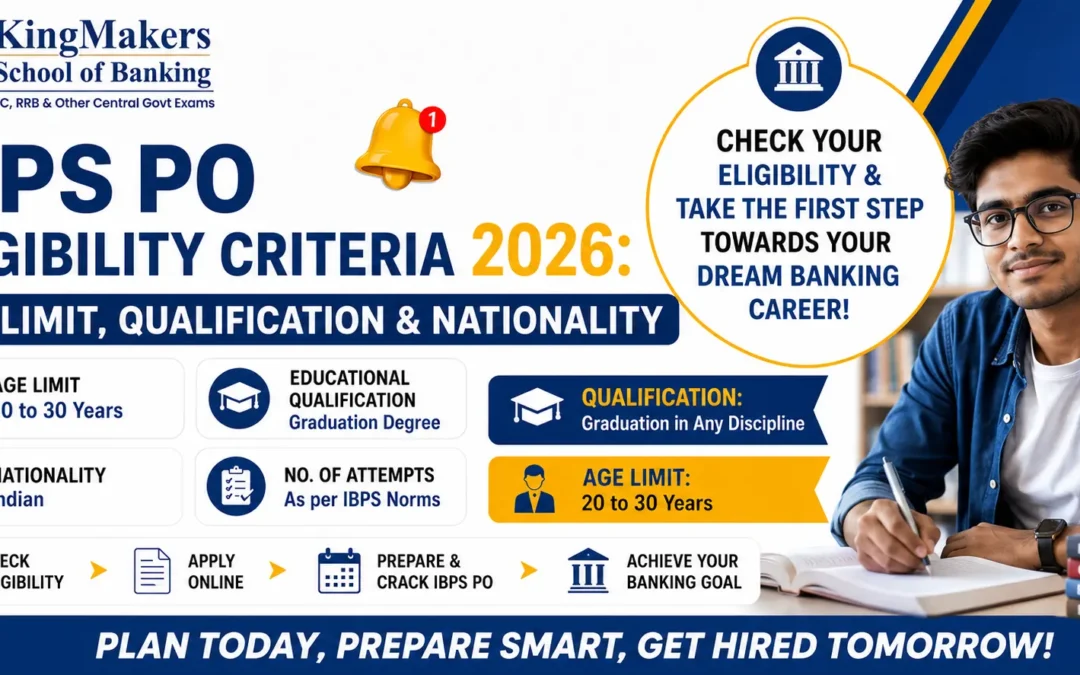
If you’re planning to apply for IBPS PO 2026, the very first thing to check out isn’t your syllabus or your mock test score, it’s whether you’re eligible to sit for the exam. The IBPS PO Eligibility Criteria 2026 covers four things: your age, your degree, your nationality, and (if you belong to a reserved category) how much age relaxation you get. Get any one of these wrong on the application form, and it can cost you a seat you actually earned through hard work.
This guide walks through each requirement using the details released alongside And you can also go through IBPS PO notification, so you can check the notification and get back here.
Quick Overview: IBPS PO Eligibility 2026 at a Glance
| Criterion | Details |
|---|---|
| Age Limit | 20 to 30 years as on 1 July 2026 (born between 2 July 1996 and 1 July 2006) |
| Qualification | Bachelor’s degree in any discipline from a recognised university |
| Minimum Percentage of bachelors degree | None – passing is enough |
| Nationality | Indian citizen, or Nepal/Bhutan subject, or Tibetan refugee (pre-1962), or specified categories of Indian-origin migrants |
| Number of Attempts | Not capped you can apply every year until you cross the upper age limit |
| Registration Window | 1 July 2026 to 21 July 2026 |
| Vacancies | 6,715 posts across 11 public sector banks |
IBPS PO Age Limit 2026: Are You in the Bracket?
Age is the one criterion you genuinely cannot fix by studying harder, so it’s worth getting exactly right.
For IBPS PO 2026, you need to be at least 20 and not more than 30 years old as on 1 July 2026. In date-of-birth terms, that means you should have been born somewhere between 2 July 1996 and 1 July 2006, with both dates counted as eligible.
If you’re a couple of months outside this window on either end, don’t assume you’re automatically out, check the age relaxation section below, because most of the aspirants qualify for extra years through category benefits.
A practical tip: calculate your age using the exact cut-off date, not the date you’re filling the form. Aspirants often make this simple arithmetic mistake and either apply when they shouldn’t have, or skip a genuine chance they had.
BPS PO Age Relaxation: Category-Wise Benefits
If you belong to a reserved category, your effective upper age limit is higher than 30. Based on the standard relaxation structure IBPS has followed and confirmed for this cycle:
| Category | Age Relaxation |
|---|---|
| SC / ST | 5 years |
| OBC (non-creamy layer) | 3 years |
| Persons with Benchmark Disabilities (General) | 10 years |
| PwBD (SC/ST) | 15 years |
| PwBD (OBC) | 13 years |
| Ex-servicemen, Commissioned Officers (incl. ECOs/SSCOs with 5+ years’ service) | 5 years |
| Persons affected by the 1984 riots | 5 years |
| Persons domiciled in J&K (1980–1989) | 5 years |
So in practice, an OBC candidate can apply up to 33 years, and an SC/ST candidate up to 35 years, provided all other conditions are met. If you’re claiming any of these, keep your category certificate valid and in the correct format an expired or wrongly formatted certificate is one of the most common reasons genuine claims get rejected at verification.
IBPS PO Qualification: What Degree Do You Need?
Here’s the part that surprises a lot of first-time applicants: IBPS PO eligibility for graduates is refreshingly open. You don’t need a commerce, economics, or banking-related degree to apply.
The requirement is simply:
- A Bachelor’s degree in any discipline — Arts, Commerce, Science, Engineering, Law, Medicine, Management, or anything else — from a university recognised by the Government of India, or
- An equivalent qualification recognised by the Central Government
There’s no minimum percentage attached to this. Whether you scored 52% or 92%, you clear this bar as long as you have a valid degree. You will, however, need to enter your graduation percentage in the application form, so if your university awards a CGPA or OGPA instead of straight marks, convert it using your university’s official formula and keep that conversion document handy you may be asked to show it later.
if you’re in your final year? You can apply, but your result needs to be officially declared on or before 21 July 2026, and you must be able to produce proof of your degree at the time of document verification. If your final-year result is delayed past that cut-off, your candidature is at risk, so this is worth confirming with your college well in advance.
One more practical requirement: basic computer literacy. Since the entire exam is conducted online and the job itself is technology-driven, IBPS expects candidates to be comfortable with computer systems, even though this usually isn’t tested as a separate qualifying round.
IBPS PO Nationality Criteria: Who Can Apply?
To be eligible, you must satisfy one of the following:
- A citizen of India
- A subject of Nepal or a subject of Bhutan
- A Tibetan refugee who came to India before 1 January 1962, intending to settle permanently
- A person of Indian origin who has migrated from Pakistan, Burma, Sri Lanka, East African countries such as Kenya, Uganda, Tanzania, Zambia, Malawi, or Zaire, or from Vietnam or Ethiopia, with the intention of permanently settling in India
If you fall under categories 2 to 4, you’ll usually need an eligibility certificate issued by the Government of India, so start that paperwork early if it applies to you. It’s not something you want to be chasing during the interview stage.
How Many Times Can You Attempt IBPS PO?
There’s genuinely good news here: IBPS does not cap the number of attempts. You can apply for the exam every year, for as many years as you like, as long as you’re still within the eligible age window (including any relaxation you qualify for). Once you cross the upper age limit for your category, that’s the only thing that stops you, not a strike system or attempt count.
This also means you can appear for IBPS PO in the same year as SBI PO, RBI Grade B, or other banking exams, since these are run by separate recruiting bodies with independent eligibility rules.
How to Calculate Your Graduation Percentage
Since the application form asks you to enter your exact graduation percentage, it’s worth knowing how IBPS wants this calculated because it’s not always the number printed on your final mark sheet.
The formula is straightforward: add up your total marks across every subject, in every semester or year, then divide that by the total maximum marks possible across those same subjects; this includes honours papers, optional subjects, and any additional optional subjects your course had. Multiply the result by 100, and that’s your IBPS-recognised percentage.
This holds true even if your university’s own degree classification (like First Class or Distinction) is based purely on your honours-subject marks. IBPS wants the overall aggregate, not the classification your university assigns.
One detail that trips people up: there’s no rounding up. If your calculated percentage comes to 49.99%, IBPS treats it as below 50%, not as 50%. The same goes for 54.99%, which is treated as below 55%. So if a cut-off or eligibility threshold depends on hitting a round number, calculating carefully a fraction of a percent can technically put you on the wrong side of the line.
If your university awards a CGPA or OGPA instead of direct percentages, convert it using your university’s own prescribed formula, and keep that conversion certificate on hand in case you’re asked to justify the number you’ve entered.
Documents You'll Need to Prove Eligibility
Keep these ready well before the interview and document verification stage:
- Graduation mark sheets and degree certificate
- Proof of date of birth (birth certificate or Class 10 certificate)
- A valid photo ID (Aadhaar, PAN, passport, or voter ID)
- Category certificate (SC/ST/OBC-NCL/EWS), if applicable
- Disability certificate, if claiming PwBD relaxation
- Nationality/domicile certificate, where relevant
- Ex-serviceman certificate, if claiming that relaxation
- No Objection Certificate, if you’re currently employed in a government or public sector role
Get these organised now rather than scrambling once results are out, verification timelines can be tight, and a missing document is an entirely avoidable way to lose a seat.
IBPS PO Medical Requirements
Clearing the exam and interview isn’t the final step; candidates provisionally selected also need to clear a medical fitness check before their appointment is confirmed. This is standard across public sector bank recruitment and isn’t something to worry about unless you have a specific pre-existing condition, but it’s worth knowing what’s involved so there are no surprises later.
Depending on the bank you’re allotted to, you may be asked to undergo some or all of the following:
- Blood test
- Serum cholesterol test
- Ultrasonography of the abdomen and pelvis
- HIV test along with serum creatinine
- ESR (Erythrocyte Sedimentation Rate) test
- Routine urine and stool examination
- Blood sugar test
- Chest X-ray (P.A. view)
The exact panel of tests can vary slightly depending on the participating bank you’re finally allotted to, so treat this as a general checklist rather than a fixed, identical list for everyone. If a report flags anything unusual, banks typically allow you to submit additional medical opinions or a review, so a single test result isn’t automatically disqualifying.
Key Takeaway
The IBPS PO Eligibility Criteria 2026 isn’t complicated, but it’s unforgiving on detail: the age cut-off date is fixed, the degree requirement is simple but non-negotiable, and category relaxations only help if your paperwork is in order. Confirm you meet every condition before you put weeks of prep time into this exam not after.
Start Your IBPS PO 2026 Preparation
Now that the IBPS PO 2026 notification has been released, it’s the right time to begin your preparation with a structured study plan. Explore our comprehensive Specialist Officer preparation resources, including updated syllabus, exam pattern, study materials, mock tests, and expert guidance to boost your chances of success.
Frequently Asked Questions
Candidates must be between 20 and 30 years old as on 1 July 2026, meaning born between 2 July 1996 and 1 July 2006, subject to category-wise relaxation.
No. IBPS does not prescribe any minimum percentage a passing degree in any discipline from a recognised university is sufficient.
Yes, but their graduation result must be officially declared on or before 21 July 2026, and proof of the degree must be produced at document verification.
Yes. Graduates from any discipline Arts, Science, Commerce, Engineering, Law, Medicine, or Management are eligible to apply.
There is no restriction on the number of attempts. You can apply every year as long as you remain within the eligible age limit for your category.
OBC candidates get 3 years' relaxation and SC/ST candidates get 5 years, taking their effective upper age limit to 33 and 35 years respectively.