Thirty days. If that’s all you’ve got left before the IBPS PO Prelims, the first thing to do is stop scrolling through panicked forum posts and start planning. It’s tight, no doubt but every year, a meaningful number of aspirants clear IBPS PO on a last-month sprint, not months of leisurely prep. What gets them through isn’t extra hours in the day. It’s a plan sharp enough to not waste a single one of them.
This guide gives you exactly that: a day-by-day, section-wise, zero-fluff roadmap to help you crack IBPS PO in 30 days, even if your starting point isn’t perfect.
Quick reality check on timing before you dive in. For the 2026 cycle, IBPS has scheduled the Prelims exam for 22nd and 23rd August, with Mains following on 4th October. Online registration closes on 21st July. If you’re reading this with roughly a month left on the clock, you’re sitting right in the window this plan is built for so lock these dates into your calendar today and build backward from them.
Overview of IBPS PO Exam
IBPS PO, officially the Common Recruitment Process for Probationary Officers and Management Trainees is how India’s public sector banks hire fresh officer-level talent every year. Run by the Institute of Banking Personnel Selection, it’s a three-stage filter: Prelims, Mains, and an Interview (with a mandatory, non-qualifying Personality Test added in recent cycles).
Here’s the shape of it in one glance:
| Stage | Nature | Sections Tested |
|---|---|---|
| Prelims | Qualifying only, not counted in final merit | English, Quantitative Aptitude, Reasoning |
| Mains | Counts heavily toward final merit (around 80%) | Reasoning & Computer Aptitude, Data Analysis & Interpretation, General/Economy/Banking Awareness, English, plus a Descriptive Paper |
| Interview | Remaining weightage in final merit | Personality, communication, banking awareness |
Prelims marks only decide who moves forward; they don’t add to your final score. Mains is where the real fight for a seat happens. Keep that in mind it’s exactly why your 30 days need to be spent almost entirely on Prelims-level speed, with Mains prep picked up right after.
Can You Crack IBPS PO in 30 Days?
The short answer is yes but only if you treat every single day as non-negotiable study time, and only if your basics aren’t starting from zero.
Here’s the longer, more honest answer. IBPS PO doesn’t test obscure or unpredictable material; it tests speed, accuracy, and familiarity with a fairly fixed set of topics. If you already have a graduation-level grip on basic maths, English grammar, and logical reasoning, 30 days is enough time to convert that into exam-ready speed. If you’re starting completely from scratch in one or more sections, 30 days will be demanding but not impossible. You’ll just need to be ruthless about which topics you invest time in.
The biggest trap in a 30-day plan is trying to “cover everything.” You don’t have the runway for that. Instead, prioritize high-frequency topics, build speed through daily timed practice, and accept that a few low-yield chapters may simply not get touched. That trade-off protects your score far better than spreading yourself thin.
Realistically, this means 7–9 hours of focused, high-intensity study a day for most aspirants working professionals will need to squeeze this into early mornings, lunch breaks, and nights, but it’s doable with discipline.
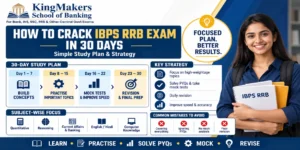
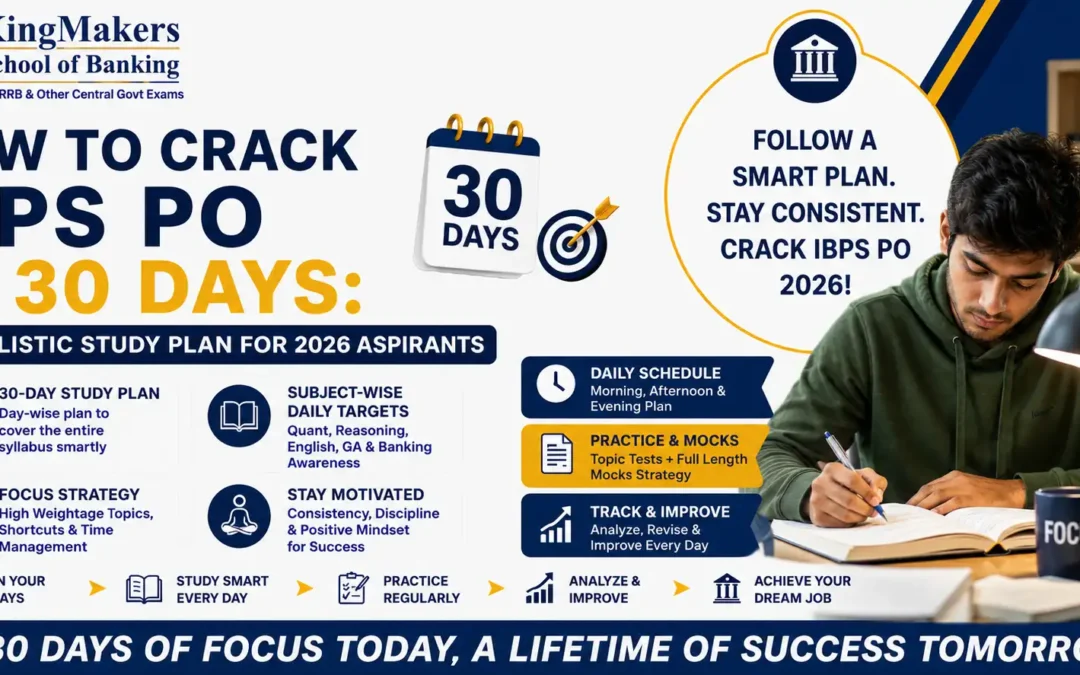
30-Day IBPS PO Study Plan
Break the 30 days into four tight blocks. A one-month plan collapses fast without structure, so don’t wing it week to week.
| Timeline | Focus Area | Key Activities |
|---|---|---|
| Days 1–7 | Rapid Concept Revision | Revise core concepts across Quantitative Aptitude, Reasoning, and English. Treat this as a refresher rather than learning from scratch. Avoid spending more than 1–2 days on any single topic. Take a short topic-wise quiz every day to ensure concepts are well understood. |
| Days 8–18 | Speed Building & Full Coverage | Solve previous year question papers section-wise, attempt sectional mock tests almost daily, and begin intensive General Awareness and Current Affairs revision. Regular repetition is essential to retain current affairs effectively. |
| Days 19–26 | Full-Length Mocks & Error Analysis | Attempt full-length Prelims mock tests on alternate days (or more frequently). After each mock, spend at least one hour analyzing mistakes, identifying weak areas, and improving accuracy. Error analysis is a crucial part of improvement during this phase. |
| Days 27–30 | Final Sprint & Light Revision | Avoid learning new topics. Revise your error log, formula sheets, and concise notes. Take one or two final mock tests during the first half of this period, then reduce study intensity in the last couple of days to stay fresh and confident for the exam. |
The moment Prelims is done, start Mains-specific prep immediately and don’t wait for results. The Descriptive Paper, Data Analysis & Interpretation, and Banking Awareness all need a head start you won’t have if you wait.
Section-wise Preparation Strategy
Quantitative Aptitude
This section rewards calculation speed more than raw knowledge. In a 30-day window, master approximation techniques, tables up to 25, squares and cubes, and percentage-to-fraction conversions immediately save you calculation time on every single question. Prioritize Data Interpretation, Simplification, Quadratic Equations, and Number Series, since they’re high-frequency and quick to score once the technique clicks. Fifteen minutes of daily mental math drills pays off faster than you’d expect.
Reasoning Ability
Puzzles and seating arrangements usually eat the most time in this section, so get comfortable with them in the first week rather than avoiding them until later. Syllogism, Inequality, and Coding-Decoding are typically fast, reliable marks if practiced daily; don’t let a tight timeline make you skip these easy wins. Set a hard rule: if a puzzle isn’t clicking within 90 seconds, mark it and move to the next question.
English Language
Reading comprehension carries the heaviest weight, so build a daily reading habit immediately. English newspaper editorials work well and double as General Awareness prep in a tight 30-day schedule. Grammar (Error Detection, Sentence Correction) needs repetition, not memorizing every exception, so focus on the most commonly tested rules first. Keep a running vocabulary list from your daily reading instead of cramming isolated word lists.
General Awareness
With only 30 days, split GA prep into two lanes and start both from day one: the last four to six months of current affairs, and static banking awareness (RBI functions, monetary policy tools, financial abbreviations, government schemes). Revising in short daily bursts rather than saving it for one long session spaced repetition is essential when time is this tight.
Computer Knowledge
Computer Knowledge isn’t separately scored in Prelims, but questions from this area show up in Mains and interview rounds. In a 30-day plan, giving it a single focused weekend covering hardware, software, MS Office shortcuts, networking terms, and banking-specific computer applications isn’t a good use of your limited time right now.
Daily Study Routine for 30 Days
With only a month, your daily routine needs to be intense but sustainable burning out on day 12 defeats the purpose. Here’s a template to adapt:
| Time of Day | Duration | Focus Area | Key Activities |
|---|---|---|---|
| Morning | 3 Hours | Quantitative Aptitude & Reasoning | Practice calculation-intensive Quant and Reasoning questions while your concentration is at its peak. |
| Afternoon | 2 Hours | English & Current Affairs | Practice English topics and read a newspaper to improve comprehension while staying updated with current affairs. |
| Evening | 2 Hours | General Awareness & Tests | Revise General Awareness topics and attempt one sectional or topic-wise mock test. |
| Night | 1 Hour | Error Analysis & Revision | Review the day’s mistakes, analyze weak areas, and update your error log before going to bed. |
Every weekend during this month should include one full-length mock test plus a detailed review session immediately after skipping this step is the single most common reason aspirants plateau in a short prep window.
Prelims vs Mains Strategy Difference
Don’t treat Prelims and Mains prep as the same task, especially with limited time they test genuinely different skills.
Prelims rewards speed and accuracy under strict sectional timing, with relatively straightforward questions. Mains rewards depth, stamina, and comfort with complexity. Data Analysis & Interpretation in Mains involves multi-step calculations and caselets that never appear in Prelims. Banking and economy awareness gets significantly more detailed. And there’s a Descriptive Paper testing essay and letter writing skill Prelims doesn’t touch at all.
In practice: spend your full 30 days sprinting through Prelims-focused timed drills, and only shift toward writing practice and deeper current affairs once Prelims is actually behind you.
Important Tips to Maximize Score
- Attempt your strongest section first in every mock to build early momentum and protect your confidence
- Don’t chase every question skipping a slow one to bank two quick wins elsewhere is usually the smarter call
- Maintain an error log from day one; with only 30 days, revisiting your own mistakes is far more valuable than solving endless fresh questions
- Simulate real exam conditions during mocks same time of day, no pauses, phone out of reach
- Protect your sleep and meals even under time pressure; a tired brain makes careless errors that cost sectional cutoffs
Common Mistakes to Avoid
- Trying to cover the entire syllabus: With 30 days, some low-yield topics have to be sacrificed allocate time by frequency of appearance, not personal comfort
- Skipping mock analysis: A test without a review afterward wastes most of its value, especially when time is this limited
- Ignoring sectional cutoffs: A strong overall score means nothing if you miss one section’s minimum requirement
- Starting a new topic in the last week: Jumping to unfamiliar material in the final days almost always hurts more than it helps
- Comparing your pace to aspirants who’ve prepped for months: Your only useful comparison is your own score trend across this month
Key Takeaway
With a month on the clock, stop collecting every PDF, app, and channel you come across hooping on all of these wastes your time. One solid arithmetic and reasoning book, a current affairs digest covering the last few months, and one reliable mock test series are enough.
The IBPS PO Exam 2026 isn’t drastically different from previous years, Now its Time to Prepare Properly Because the days left is very less and You can Crack Easily but only if you treat every single day as non-negotiable study time, and only if your basics aren’t starting from zero.
Frequently Asked Questions
Yes, for aspirants with a reasonable existing grip on basic maths, English, and reasoning. Success depends on daily consistency and honest mock analysis, not on having months of prep time.
Seven to nine focused hours daily is realistic for most aspirants in a one-month plan, split across all three Prelims sections along with General Awareness.
Start with whichever section you're weakest in during the first week, since it needs the most concept revision. Move to speed-building on your stronger sections soon after.
Aim for 10–12 full-length mock tests, along with near-daily sectional tests, especially from the second half of the month onward.
Not necessarily. Many aspirants clear IBPS PO through focused self-study using a couple of reliable books and a mock series, provided they stay disciplined every single day of the month.
Prelims consists of 100 objective questions across English, Quantitative Aptitude, and Reasoning, with sectional timing. Mains includes an objective test across four sections plus a separate Descriptive Paper for essay and letter writing.
Not entirely, and that's fine. Focus on high-frequency topics and build speed there a 30-day plan is about smart prioritization, not exhaustive coverage.
For More Detailed Information, read these blogs also: