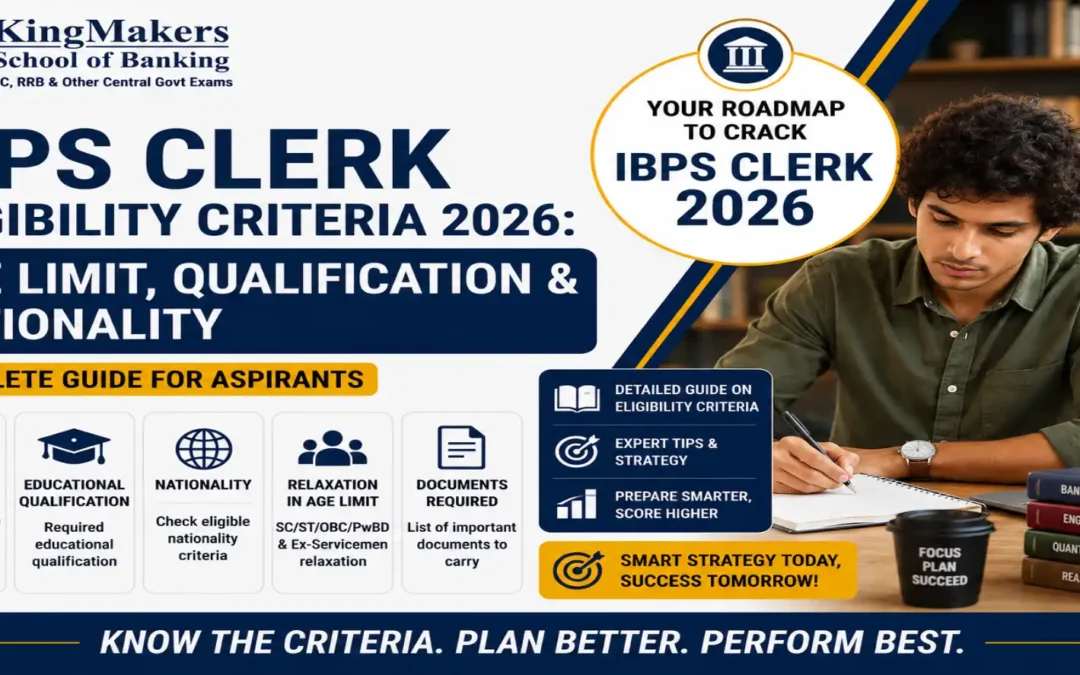
Before you touch a single mock test, you need to be sure you actually qualify to sit for the exam. The IBPS Clerk Eligibility Criteria 2026 covers three pillars: your age, your educational qualification, and your nationality and for candidates from reserved categories, a fourth: age relaxation. IBPS has released these requirements under the CRP CSA-XVI notification (the recruitment cycle for Customer Service Associate posts, popularly still called “IBPS Clerk”), and getting even one condition wrong on your application form can quietly disqualify a candidate who was otherwise fully prepared.
This guide breaks down the complete IBPS Clerk Eligibility Criteria: the age bracket, the exact cut-off date, category-wise relaxation, the degree you need, and who counts as a valid Indian national for this exam so you can confirm your eligibility before you invest weeks into preparation.
Want to check the IBPS Clerk Notification 2026? Click Here
IBPS Clerk Eligibility Criteria 2026: Overview
Criterion | Details |
Age Limit | 20 to 28 years as on 1 August 2026 (born between 2 August 1998 and 1 August 2006) |
Educational Qualification | Bachelor’s degree in any discipline from a recognised university |
Minimum Percentage in Graduation | None – a passing degree is sufficient |
Nationality | Indian citizen, or Nepal/Bhutan subject, or Tibetan refugee (pre-1962), or specified categories of Indian-origin migrants |
Number of Attempts | Not capped you can apply every year until you cross the upper age limit for your category |
Registration Window | 1 August 2026 to 21 August 2026 |
Vacancies | 11,403 Customer Service Associate posts across 11 public sector banks |
Now let’s look at each requirement in detail, starting with the one that trips up the most candidates: age.
IBPS Clerk Age Limit 2026 & Date of Birth Criteria
Unlike your degree or your prep level, your age isn’t something you can fix with extra effort so it’s worth calculating exactly, not approximately.
For IBPS Clerk Age Limit 2026, you need to be at least 20 years old and not more than 28 years old as on 1 August 2026. In date-of-birth terms:
Particular | Requirement |
Minimum age | 20 years |
Maximum age | 28 years |
Age calculation date | 1 August 2026 |
Earliest eligible date of birth | 2 August 1998 |
Latest eligible date of birth | 1 August 2006 |
Both boundary dates count as eligible. So a General or EWS candidate needs a date of birth falling between 2 August 1998 and 1 August 2006, inclusive, to clear the basic IBPS Clerk date of birth criteria.
Date of Birth | Basic Eligibility |
Before 2 August 1998 | Not eligible, unless applicable age relaxation applies |
2 August 1998 to 1 August 2006 | Eligible under the basic age criteria |
After 1 August 2006 | Not eligible minimum age of 20 years not met |
Why the age calculation date matters: IBPS fixes age strictly against 1 August 2026 not the date you submit your form, and not your age today. A candidate who turns 28 in September 2026 is still within the bracket for this cycle, because the cut-off, not the application date, decides eligibility. Aspirants frequently miscalculate this and either skip a cycle they were actually eligible for, or apply in a year they’ve already aged out of. Always work backward from the official cut-off date given in the notification, not from your current age.
Age relaxation only stretches the upper limit; it never lowers the minimum age of 20 years for any category.
IBPS Clerk Category-Wise Age Relaxation 2026
Reserved-category and special-category candidates get additional years added to the upper age limit. Here’s the full IBPS Clerk age relaxation structure for SC, ST, OBC, EWS, and PwBD candidates:
Category | Upper Age Relaxation | Effective Maximum Age |
General | No relaxation | 28 years |
EWS | No relaxation | 28 years |
OBC – Non-Creamy Layer | 3 years | 31 years |
Scheduled Caste (SC) | 5 years | 33 years |
Scheduled Tribe (ST) | 5 years | 33 years |
Persons with Benchmark Disabilities (PwBD) | 10 years | Up to 38 years* |
Ex-Servicemen / Disabled Ex-Servicemen | Defence service + 3 years | Maximum 50 years |
Disabled Ex-Servicemen (SC/ST) | Defence service + 8 years | Maximum 50 years |
Widows/Divorced/Legally Separated Women (not remarried) – General/EWS | Up to 35 years | 35 years |
Widows/Divorced/Legally Separated Women (not remarried) – OBC | Up to 38 years | 38 years |
Widows/Divorced/Legally Separated Women (not remarried) – SC/ST | Up to 40 years | 40 years |
*PwBD relaxation can be combined with SC, ST, or OBC-NCL relaxation where the notification permits it see the cumulative relaxation rules below.
This means an OBC-NCL candidate can apply up to 31 years of age, and an SC/ST candidate up to 33 years, provided every other IBPS Clerk SC, ST, OBC, EWS, PwBD condition is met and the supporting certificate is valid and correctly formatted. An expired certificate, or one missing the prescribed clause, is one of the most common reasons a genuine relaxation claim gets rejected during document verification so don’t leave this for the last week before the exam.
Maximum Age for PwBD Candidates
Persons with Benchmark Disabilities receive 10 years of upper-age relaxation, and this can stack with SC/ST or OBC-NCL relaxation under the cumulative rules.
PwBD Category | Maximum Age |
PwBD – General/EWS | 38 years |
PwBD – OBC-NCL | 41 years |
PwBD – SC/ST | 43 years |
A valid disability certificate, issued by a competent authority under the applicable rules, is mandatory to claim this benefit.
Maximum Age for Widows and Divorced Women
Special age concession applies to widows, divorced women, and women legally separated from their husbands (who have not remarried):
Category | Maximum Permissible Age |
General/EWS | 35 years |
OBC-NCL | 38 years |
SC/ST | 40 years |
Documentary proof of marital status, a death certificate, divorce decree, or legal separation document is required at the appropriate stage of recruitment.
Age Relaxation for Ex-Servicemen
For Ex-Servicemen and Disabled Ex-Servicemen, relaxation is calculated against actual defence service, not a flat number of years.
Category | Formula for Permissible Age |
General Ex-Servicemen | Basic maximum age + actual defence service rendered + 3 years |
Disabled Ex-Servicemen (SC/ST) | Basic maximum age + actual defence service rendered + 8 years |
In either case, the final permissible age cannot exceed 50 years. Candidates still in active service can apply under the Ex-Servicemen category as long as their engagement period ends on or before the date specified in the notification, subject to the standard conditions.
Cumulative Age Relaxation Rules
SC, ST, and OBC-NCL candidates can combine their category relaxation with one additional relaxation from among:
- Persons with Benchmark Disabilities
- Ex-Servicemen/Disabled Ex-Servicemen
- Widows, divorced women, and legally separated women who have not remarried
For example, an OBC-NCL candidate with a benchmark disability gets 3 years of OBC relaxation plus 10 years of PwBD relaxation. An SC/ST candidate with a benchmark disability gets 5 years of SC/ST relaxation plus 10 years of PwBD relaxation. You can’t stack relaxations without meeting the eligibility and paperwork requirements for both categories independently; partial documentation for either one can invalidate the combined claim.
Important Conditions for OBC Candidates
Only the Non-Creamy Layer within OBC qualifies for the 3-year relaxation and reserved-category benefit; this is the single most misunderstood condition in IBPS Clerk educational qualification and reservation queries.
- Creamy-layer OBC candidates are not eligible for OBC reservation or relaxation, and must apply as General candidates.
- The certificate must explicitly carry the Non-Creamy Layer clause, in the Government of India’s prescribed format a generic caste certificate without this clause will not be accepted.
- For provisionally allotted candidates, the OBC-NCL certificate needs to be issued on or after the date fixed in the notification and must still be valid at document verification.
How to verify your OBC-NCL status before applying: Check your family income and asset details against the current creamy-layer income ceiling notified by the Ministry of Social Justice and Empowerment, and get a fresh certificate from your local Tehsildar or the designated issuing authority don’t reuse a certificate issued for a different purpose or an earlier recruitment cycle, since IBPS checks the issue date against its own window.
Important Conditions for EWS Candidates
EWS candidates are treated the same as General candidates on age:
- Minimum age: 20 years
- Maximum age: 28 years
- No separate upper-age relaxation purely on the basis of EWS status
The EWS certificate must be valid for the current financial year as prescribed in the notification and must correspond to the correct income and asset criteria. An outdated EWS certificate from a previous year is a common rejection reason.
IBPS Clerk Qualification 2026
The good news on the IBPS Clerk Qualification 2026 front: it’s genuinely open. You don’t need a commerce, banking, or finance-specific degree.
The requirement is simply:
- A Bachelor’s degree in any discipline Arts, Commerce, Science, Engineering, Law, Medicine, Management, or any other stream from a university recognised by the Government of India, or
- An equivalent qualification recognised by the Central Government
There is no minimum percentage attached to this requirement. Whether you scored 50% or 95%, a passing degree clears the bar. You will still need to enter your graduation percentage on the application form; if your university issues a CGPA or OGPA instead of straight marks, convert it using your university’s own prescribed formula and hold on to that conversion certificate in case you’re asked to justify the figure later.
If you’re in your final year: you can apply, but your result needs to be officially declared on or before the last date fixed by IBPS for the exam year, and you must be able to produce proof of your degree at document verification. Confirm your likely result date with your college well ahead of time a delayed result past the cut-off puts your candidature at risk.
IBPS also expects basic computer literacy from every applicant, since the entire selection process from registration to the online exam runs digitally, even though this usually isn’t tested as a separate qualifying round. Some participating banks additionally prefer working knowledge of the local/official language of the state you’re applying for, so check the specific bank preference conditions in the notification before selecting your bank choices.
IBPS Clerk Nationality Criteria
To meet the IBPS Clerk Nationality requirement, you must fall into one of these categories:
- A citizen of India
- A subject of Nepal or a subject of Bhutan
- A Tibetan refugee who came to India before 1 January 1962, with the intention of permanently settling here
- A person of Indian origin who has migrated from Pakistan, Burma, Sri Lanka, East African countries (Kenya, Uganda, Tanzania, Zambia, Malawi, Zaire), Vietnam, or Ethiopia, with the intention of permanently settling in India
Documents that prove nationality: For category 1, a passport, voter ID, Aadhaar linked to an Indian address, or a domicile/nationality certificate issued by a competent authority is generally accepted as proof. For categories 2 to 4, you’ll need an eligibility certificate specifically issued by the Government of India confirming your status. This is not something you can get overnight, so start that paperwork well before the application window opens if it applies to you. Leaving this to the interview or document-verification stage is one of the more avoidable ways candidates lose an otherwise-earned seat.
Documents Required to Claim Age Relaxation
Keep the following ready, in original and photocopy form, for document verification, joining, or any other stage IBPS or the allotted bank specifies:
- Date-of-birth proof (birth certificate or Class 10 certificate/mark sheet)
- SC/ST caste certificate, where applicable
- OBC-NCL certificate carrying the Non-Creamy Layer clause
- EWS certificate valid for the correct financial year
- PwBD/disability certificate issued by a competent authority
- Ex-Servicemen discharge or service certificate, or certificate for currently serving personnel
- Death certificate, divorce decree, or legal separation documents for widow/divorced-women relaxation
- Valid photo ID (Aadhaar, PAN, passport, or voter ID)
- Nationality/domicile certificate, where relevant
- Any other certificate specifically prescribed in the official notification
Failure to produce a valid document at the required stage can cancel your candidature even after you’ve cleared the exam and interview — so treat this checklist as seriously as your syllabus.
How Is Age Calculated for IBPS Clerk 2026?
Your age is calculated strictly as on 1 August 2026. A few worked examples make this concrete:
- Born on 2 August 1998 → eligible (earliest permitted date of birth)
- Born on 1 August 2006 → eligible (latest permitted date of birth)
- A General candidate born on 1 August 1998 → exceeds the basic maximum age; not eligible without relaxation
- Born on 2 August 2006 → hasn’t reached the minimum age of 20; not eligible
Always enter the same date of birth that appears on your Class 10 certificate or other officially accepted record. A mismatch between your application form and your certificates is flagged during verification and can hold up your candidature even when your actual age is within range.
Common Mistakes Candidates Make During Eligibility Verification
- Using the application date instead of the official cut-off date to calculate age, which can misjudge eligibility by months.
- Submitting an OBC certificate without the Non-Creamy Layer clause, or one issued outside the valid window for the current cycle.
- Rounding up a borderline graduation percentage — IBPS does not round; 49.99% is treated as below 50%, not as 50%.
- Assuming EWS or OBC certificates carry over from a previous exam cycle without checking the issue-date requirement for the current notification.
- Delaying nationality eligibility-certificate paperwork for candidates under categories 2–4, which can’t be arranged quickly once document verification is close.
- Entering a date of birth on the form that doesn’t match Class 10 records, causing an avoidable mismatch flag at verification.
Key Takeaway
The IBPS Clerk Eligibility Criteria 2026 isn’t complicated, but it rewards precision: the age cut-off date is fixed and non-negotiable, the qualification bar is simple but firm, nationality documentation needs lead time for certain categories, and category-wise age relaxation only helps if your certificates are valid and correctly formatted. Confirm every condition, age, qualification, and nationality before you commit weeks of preparation to the CRP CSA-XVI cycle, not after your application is already submitted.
IBPS Exam Guides
- ibps so notification 2026
- ibps po notification 2026
- ibps po eligibility criteria
- ibps po syllabus 2026
- ibps clerk notification 2026
Start Your IBPS Clerk Preparation 2026
Now that the IBPS Clerk 2026 notification has been released, it’s the right time to begin your preparation with a structured study plan. Explore our comprehensive Specialist Officer preparation resources, including updated syllabus, exam pattern, study materials, mock tests, and expert guidance to boost your chances of success.
Frequently Asked Questions
Candidates must be between 20 and 28 years old as on 1 August 2026, meaning born between 2 August 1998 and 1 August 2006, subject to category-wise relaxation.
OBC-NCL candidates get 3 years of relaxation, taking their effective upper age limit to 31 years.
SC and ST candidates each get 5 years of relaxation, taking their effective upper age limit to 33 years.
No. EWS candidates follow the same age criteria as General candidates 20 to 28 years with no separate age relaxation for EWS status alone.
No. IBPS does not prescribe any minimum percentage; a passing Bachelor's degree in any discipline from a recognised university is sufficient.
Yes, provided their graduation result is officially declared by the date fixed in the notification and they can produce proof of the degree at document verification.
No. There's no cap on attempts you can apply every year as long as you remain within the eligible age limit (including any relaxation) for your category.
Indian citizens, subjects of Nepal or Bhutan, Tibetan refugees who arrived before 1 January 1962, and specified categories of Indian-origin migrants from countries such as Pakistan, Burma, Sri Lanka, and select East African nations.