If you’re preparing for the Customer Service Associate post this year, the IBPS Clerk Exam Pattern 2026 is the first thing you need to lock into your head before you open a single mock test. It decides how you split your study hours, which sections carry real weight, and where a wrong guess actually costs you.
The recruitment runs under CRP CSA-XVI Notification, and it follows the familiar two-tier structure: a qualifying Preliminary Examination followed by a Main Examination that alone decides your merit. There’s no interview. What has changed this year is the Mains paper itself: more questions, more time, and a reshuffled Quantitative Aptitude section. This guide walks you through the Prelims and Mains pattern section by section, the negative marking system, how cut-offs and final merit work, and what the Local Language Proficiency Test involves, so you know exactly where to put your preparation time.
IBPS Clerk Exam Pattern at a Glance
Parameter | Prelims | Mains |
Mode of examination | Online | Online |
Examination stage | Qualifying | Merit-determining |
Number of sections | 3 | 4 |
Total questions | 100 | 160 |
Maximum marks | 100 | 200 |
Total duration | 60 minutes | 125 minutes |
Sectional timing | Separate timer per section | Separate timer per section |
Negative marking | 0.25 marks per wrong answer | 0.25 marks per wrong answer |
Sectional cut-off | Yes | Yes |
Overall cut-off | Yes | Yes |
Counts toward final merit | No | Yes |
Prelims marks only get you through the door to Mains; they play no part in your final ranking. Everything that decides your selection happens in the Main Examination.
IBPS Clerk Selection Process 2026
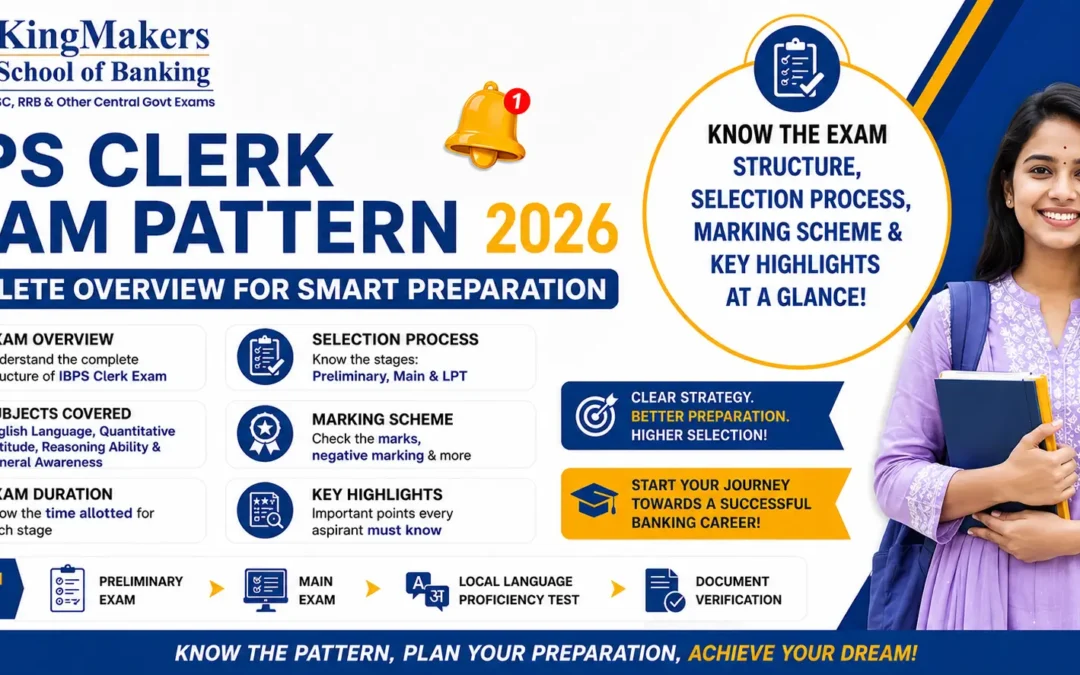
Selection for the Customer Service Associate post happens in three stages:
- Preliminary Examination — qualifying in nature; clears you for Mains only.
- Main Examination — scoring in nature; this is where your final merit is built.
- Local Language Proficiency Test (LLPT) — qualifying; conducted after Mains, before final allotment.
There is no interview anywhere in this process. Candidates who clear Mains and the LLPT are considered for provisional allotment to a participating bank based on merit, category, and state or UT preference.
IBPS Clerk Prelims Exam Pattern 2026
The Preliminary Examination has stayed unchanged this cycle: three sections, 100 questions, 100 marks, and a strict 60-minute window split into three 20-minute blocks. You cannot move time from one section to another once a section’s clock runs out, it locks and moves you to the next.
Section | Questions | Maximum Marks | Sectional Duration |
English Language | 30 | 30 | 20 minutes |
Numerical Ability | 35 | 35 | 20 minutes |
Reasoning Ability | 35 | 35 | 20 minutes |
Total | 100 | 100 | 60 minutes |
You need to clear the minimum cut-off in each of these three sections individually, not just the combined total, to move ahead to Mains.
IBPS Clerk Mains Exam Pattern 2026
This is where the 2026 cycle looks different from earlier years. Under the CRP CSA-XVI notification, the Main Examination now runs to 160 questions across four sections, carries 200 marks, and gets 125 minutes instead of the shorter window used in recent cycles. The change centres on Quantitative Aptitude, which has gained five extra questions and five extra minutes of sectional time.
Section | Questions | Maximum Marks | Sectional Duration |
General/Financial Awareness | 40 | 50 | 20 minutes |
English Language | 40 | 40 | 35 minutes |
Reasoning Ability | 40 | 60 | 35 minutes |
Quantitative Aptitude | 40 | 50 | 35 minutes |
Total | 160 | 200 | 125 minutes |
Two things stand out here. First, Reasoning Ability carries the highest marks of any section despite an equal question count. Some questions in this section are weighted higher than others. Second, Quantitative Aptitude’s extra five questions and five extra minutes mean the pace per question has eased slightly compared to the older 30-minute format, though the section is still widely considered the most time-intensive in Mains.
Note: figures above reflect the pattern reported following the CRP CSA-XVI notification released on 1 August 2026. Since IBPS occasionally issues addenda close to the exam, cross-check the section-wise breakup against the official notification PDF on ibps.in before finalising your study plan.
Important Features of the Prelims and Mains Pattern
- Both stages are conducted online as computer-based tests.
- Every section in both Prelims and Mains has its own fixed timer; you cannot borrow time across sections.
- Both sectional and overall cut-offs apply at every stage.
- Prelims marks are used only for shortlisting; they carry zero weight in the final merit list.
- General/Financial Awareness appears only in Mains, not in Prelims.
- The exam is conducted bilingually in English and Hindi, except for the English Language section, which is tested only in English.
Negative Marking in IBPS Clerk 2026
Every wrong answer costs you 0.25 marks, a flat one-fourth deduction of the marks allotted to that question, applied uniformly across Prelims and Mains. Unattempted questions carry no penalty at all.
Here’s a simple example. Suppose in the Prelims Reasoning Ability section, worth 1 mark per question, you attempt 28 out of 35 questions. If 22 of those are correct and 6 are wrong, your score for that section works out to:
- Marks for correct answers: 22 × 1 = 22
- Deduction for wrong answers: 6 × 0.25 = 1.5
- Net section score: 22 − 1.5 = 20.5 marks
The seven questions you skipped entirely don’t affect your score either way. This is why guessing blindly on questions you’re genuinely unsure about can hurt more than it helps, especially in sections like Reasoning where some questions in Mains carry more than one mark each.
Sectional and Overall Cut-off
IBPS sets two layers of qualifying marks at both Prelims and Mains: a minimum score for each individual section, and a minimum aggregate score across all sections combined. You have to clear both a strong overall score doesn’t help if you fall short in even one section.
Cut-offs are decided after each exam is conducted, based on factors like the difficulty level of that particular paper, the number of candidates who appeared, category-wise reservation norms, and state or UT-wise vacancies. They are never published in advance, and they typically vary from year to year and category to category.
Score Normalization
When IBPS conducts an exam across multiple shifts or sessions on different days, it may apply an equipercentile normalization method to adjust scores for variation in difficulty between shifts, so that no candidate is disadvantaged purely because of which shift they were allotted. This applies only when multiple sessions are held; check the official notification for confirmation of whether normalization is being used for the 2026 cycle, since IBPS states shift-specific policy separately each year.
How Final Merit Is Prepared
The final merit list is built entirely from Main Examination scores. Candidates are ranked category-wise and state/UT-wise based on their Mains marks, after clearing both the sectional and overall Mains cut-offs. Prelims marks play no role at this stage; they’ve already served their purpose of shortlisting candidates for Mains. Candidates who make the merit list still need to clear the LLPT before they can be provisionally allotted to a bank.
Local Language Proficiency Test (LLPT)
The LLPT is a mandatory qualifying stage for most candidates, conducted after the Main Examination and before final allotment.
- Purpose: to confirm that a candidate can read, write, speak, and understand the official language of the state or UT they’ve applied to, since Customer Service Associates deal directly with local customers.
- Applicable candidates: those shortlisted based on their Mains performance for a specific state or UT.
- Language requirement: the local or official language notified for that particular state or UT.
- Nature: qualifying only — it does not add marks to your merit score.
- Timing: conducted after the Mains result and before final allotment, typically closer to the joining stage.
- Exemption: candidates who have studied the relevant local language as a subject up to the 10th standard, and can produce a mark sheet or certificate as proof, are generally exempted from appearing.
- Consequence of not clearing: failure to qualify the LLPT, or failure to produce a valid exemption certificate, can result in disqualification from the recruitment process for that particular state or UT, even after clearing Mains.
Always confirm the exact language list and exemption documentation required for your state against the official notification, since these details are state-specific and set out separately for each cycle.
Languages and Medium of Examination
Both the Preliminary and Main Examinations are conducted bilingually, in English and Hindi, with one exception: the English Language section itself is tested only in English, since it’s assessing your command of that language specifically. Candidates choose their preferred medium English or Hindi for the other sections at the time of application or before the exam, depending on the option IBPS provides that year.
Common Mistakes Candidates Should Avoid
- Treating Prelims casually because “only Mains counts” you still need to clear Prelims to get a Mains attempt at all.
- Ignoring sectional cut-offs and focusing only on the overall score.
- Skipping timed practice and only solving questions section by section without a clock running.
- Underestimating General/Financial Awareness in Mains since it doesn’t appear in Prelims at all.
- Guessing randomly on unfamiliar questions instead of accepting a safe skip.
- Leaving Quantitative Aptitude preparation too light, assuming the extra five minutes this year makes up for weak fundamentals.
- Forgetting to check LLPT language requirements and exemption documentation well before the Mains result is out.
Preparation Strategy Based on the Exam Pattern
- Build section-wise speed, not just accuracy. Since every section in both Prelims and Mains runs on its own clock, practice each section in isolation under its actual time limit before attempting full-length mocks.
- Prioritise Numerical Ability and Reasoning for Prelims, since together they make up 70 of your 100 Prelims marks and set the tone for how comfortably you enter Mains.
- Start General/Financial Awareness early for Mains. It’s a static and current-affairs-heavy section that rewards consistent daily reading far more than last-minute cramming.
- Give Quantitative Aptitude dedicated daily practice, since it remains one of the more time-consuming sections in Mains even with the extra five minutes.
- Attempt sectional cut-offs strategically — don’t over-invest time chasing extra marks in a section once you’re comfortably past its likely cut-off; redirect that time to a weaker section instead.
- Take full-length mocks regularly in the exact 125-minute Mains format to build stamina for the longer, sectional-timed paper.
IBPS Exam Guides
Frequently Asked Questions
It's a two-tier online examination: a Preliminary Exam of 100 questions for 100 marks in 60 minutes, followed by a Main Exam of 160 questions for 200 marks in 125 minutes. Prelims is purely qualifying, while Mains marks alone decide the final merit list. There is no interview stage in this recruitment.
Yes. Under the CRP CSA-XVI notification, Mains now has 160 questions instead of the previous cycle's count, and the total duration has increased to 125 minutes. The change is concentrated in Quantitative Aptitude, which now has 40 questions and 35 minutes of sectional time, while still carrying 50 marks.
No. The Preliminary Examination pattern remains the same as previous cycles — three sections, 100 questions, 100 marks, and 60 minutes total, with 20 minutes fixed for each section.
A flat 0.25 marks is deducted for every wrong answer, in both Prelims and Mains. There is no penalty for questions you leave unattempted, so a careful skip is always safer than a random guess.
No. Prelims marks are used only to shortlist candidates for Mains. Once you clear Prelims, those marks are set aside completely, and your final rank is based only on your Mains score.
No. IBPS Clerk recruitment for the Customer Service Associate post does not include an interview. Selection depends entirely on the Main Examination score, followed by clearing the Local Language Proficiency Test.
It's a qualifying test conducted after Mains to confirm a candidate can read, write, speak, and understand the official language of the state or UT they applied for. Candidates who studied that language up to the 10th standard are generally exempted on producing proof, and failing to clear it or provide valid exemption documents can lead to disqualification even after clearing Mains.
Yes. Both stages require candidates to clear the minimum qualifying marks set for each individual section, in addition to an overall aggregate cut-off. Falling short in even one section can disqualify an otherwise strong overall score.
125 minutes, split into four separately timed sections: General/Financial Awareness (20 minutes), English Language (35 minutes), Reasoning Ability (35 minutes), and Quantitative Aptitude (35 minutes).
The most reliable source is the official CRP CSA-XVI notification and detailed syllabus PDF published on ibps.in. Since sectional details can be revised close to the exam, it's worth cross-checking figures there before finalising your preparation plan.
Final Takeaway
The IBPS Clerk Exam Pattern 2026 makes one thing clear: Prelims gets you to the starting line, but Mains is the exam that decides your career. With Mains now stretched to 160 questions and 125 minutes, and Quantitative Aptitude carrying a slightly eased but still demanding sectional window, the aspirants who build genuine section-wise speed not just topic knowledge are the ones who’ll clear both the sectional and overall cut-offs comfortably. Study the pattern, respect the sectional timers, and put your heaviest hours where the marks actually live: General/Financial Awareness and Quantitative Aptitude in Mains.
Start Your IBPS Clerk Preparation 2026
Now that the IBPS Clerk 2026 notification has been released, it’s the right time to begin your preparation with a structured study plan. Explore our comprehensive Specialist Officer preparation resources, including updated syllabus, exam pattern, study materials, mock tests, and expert guidance to boost your chances of success.