If you’re preparing for IBPS SO with an old syllabus PDF saved from last year, stop right there. The IBPS SO (CRP SPL-XVI) notification for 2026 has reshuffled the exam structure in a way that changes how you should be studying, not just what you should be studying.
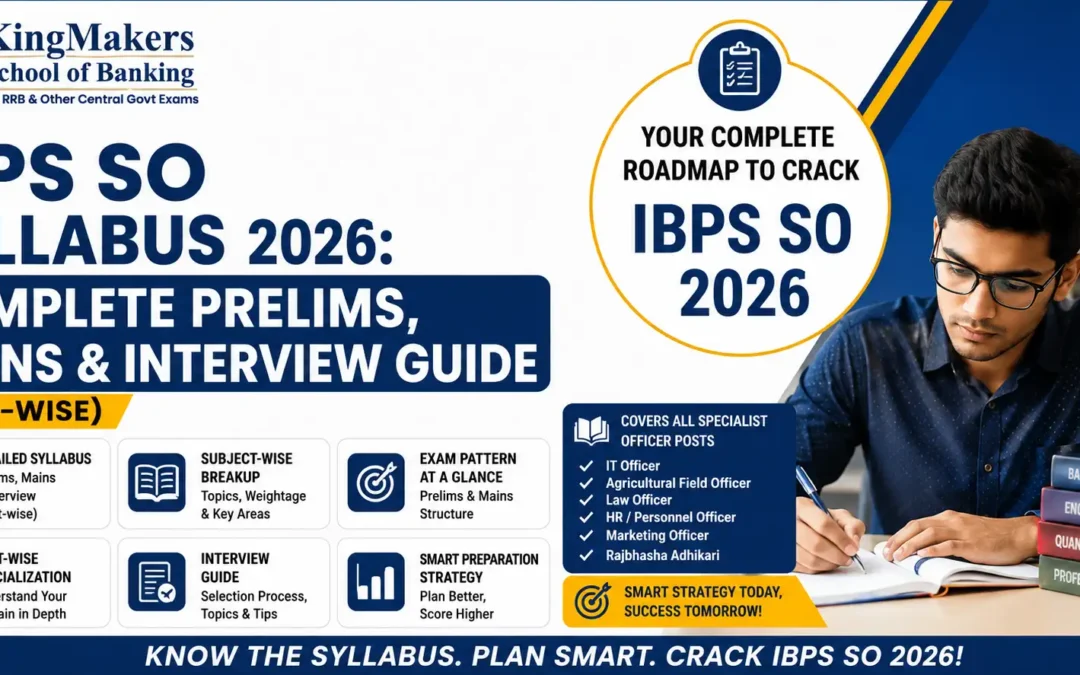
This guide breaks down the complete IBPS SO Syllabus 2026 the revised Prelims and Mains pattern, section-wise topics for every stage, and the full post-wise Professional Knowledge syllabus for IT Officer, Agriculture Field Officer, Law Officer, HR/Personnel Officer, Marketing Officer, and Rajbhasha Adhikari.
IBPS SO Selection Process 2026
IBPS SO recruitment (CRP SPL-XVI) runs across three stages, and clearing one is the only way to unlock the next:
- Prelims – A qualifying round; your score here doesn’t feed into the final merit list
- Mains – An objective paper plus a descriptive test; this is where your actual ranking gets decided
- Interview – Conducted by the participating bank and coordinated through the nodal bank in each state
Here’s the detail most aspirants gloss over: within Mains itself, every section except Professional Knowledge is only qualifying in nature. Your final merit is built from your Professional Knowledge score in Mains plus your Interview score, combined in an 80:20 ratio. In other words, English, Reasoning, and Quant/GA in Mains just need to clear the cutoff, Professional Knowledge is what actually earns you your rank.
Quick reality check: the IBPS SO 2026 notification (released 30th June 2026 under CRP SPL-XVI) opened applications for specialist roles across 11 participating public sector banks, and the total vacancy count was later revised upward from 745 to 1,035 posts. With more seats now on the table, the exam still rewards depth in your specialization far more than generalist prep, so don’t let the revised numbers tempt you into coasting.
IBPS SO Exam Pattern 2026 (Prelims + Mains + Interview)
Prelims Pattern
The big structural change this year: Professional Knowledge has moved into Prelims for the first time. It used to show up only in Mains.
Section | Applicable Posts | Questions | Marks | Duration |
English Language | All posts | 25 | 25 | 20 minutes |
Reasoning Ability | All posts | 25 | 25 | 20 minutes |
Quantitative Aptitude | IT Officer, AFO, HR/Personnel Officer, Marketing Officer | 25 | 25 | 20 minutes |
General Awareness (Banking) | Law Officer, Rajbhasha Adhikari | 25 | 25 | 20 minutes |
Professional Knowledge | All posts | 25 | 50 | 20 minutes |
Total | 100 | 125 | 80 minutes |
Each section runs on its own 20-minute clock, so you can’t shift time from one to rescue another. Professional Knowledge now carries double the marks-per-question of the other sections, which tells you exactly where Prelims prep should be weighted even at this early stage.
Negative marking applies: 0.25 marks deducted per wrong answer, nothing deducted for unattempted questions.
Mains Pattern
Mains has also been expanded this year, and it’s built almost entirely around your domain knowledge.
Section | Questions | Marks | Duration |
Objective Paper (English, Reasoning, Quant/GA, Professional Knowledge) | 150 | 200 | 125 minutes |
Descriptive Test (English Writing) | 2 | 25 | 30 minutes |
Grand Total | 152 | 225 | 155 minutes |
A few things worth flagging:
- Within the objective paper, only Professional Knowledge marks count toward your final merit. English, Reasoning, and Quant/GA are qualifying sections you need to clear, not chase for score.
- The Descriptive Test is an English writing paper, typically essay and comprehension-style questions, and it’s also qualifying rather than merit-deciding.
- Post-wise Professional Knowledge is where nearly all your effective marks come from, which is a very different balance from IBPS PO or Clerk.
- Same negative marking rule applies: -0.25 per wrong objective answer, no penalty for skipped questions.
Interview & Personality Assessment
Candidates who clear Mains move to the Interview stage, worth 100 marks. Minimum qualifying marks: 40% (35% for SC/ST/OBC/PwBD candidates). Final selection combines your Mains Professional Knowledge score and Interview score in an 80:20 ratio, followed by provisional allotment to participating banks.
IBPS SO Prelims Syllabus 2026 (Post-wise)
The Prelims syllabus splits into two groups depending on which post you’re applying for.
For IT Officer, Agriculture Field Officer, HR/Personnel Officer, and Marketing Officer, Prelims tests: English Language, Reasoning Ability, Quantitative Aptitude, and Professional Knowledge.
For Law Officer and Rajbhasha Adhikari, Quantitative Aptitude is swapped out for General Awareness with Special Reference to the Banking Industry.
English Language Syllabus
Topic | What It Tests |
Reading Comprehension | Factual, inference-based, and vocabulary-in-context passages |
Cloze Test | Choosing the right word to complete a passage |
Error Detection | Spotting grammatical or contextual mistakes |
Sentence Improvement | Rewriting for grammatical accuracy |
Fill in the Blanks | Single or double blanks testing vocabulary and grammar |
Para Jumbles | Reordering scrambled sentences into a logical paragraph |
Sentence Rearrangement | Sequencing statements correctly |
Phrase Replacement | Swapping out an awkward or incorrect phrase |
Word Swap | Exchanging words to fix sentence meaning |
Connectors | Choosing the right conjunction to join ideas |
Vocabulary | Synonyms, antonyms, one-word substitutions, idioms |
Grammar | Tenses, articles, prepositions, subject-verb agreement, voice, narration |
Reasoning Ability Syllabus
Topic | Expected Focus |
Seating Arrangement | Linear, circular, square, double-row formats |
Puzzles | Floor-based, box-based, scheduling, distribution, month-based |
Syllogism | Statement-based logical conclusions |
Inequalities | Direct and coded inequality chains |
Coding-Decoding | Letter, number, and symbol-based coding |
Blood Relations | Family tree and coded relationship problems |
Direction Sense | Distance and direction-based questions |
Ranking & Order | Position and sequence-based questions |
Alphabet & Number Series | Pattern recognition in letter or number sequences |
Data Sufficiency | Judging whether given statements are enough to answer |
Input-Output | Machine-based rearrangement problems |
Statement-based Reasoning | Assumptions, conclusions, cause-effect, course of action |
Quantitative Aptitude Syllabus
(Applicable for IT Officer, Agriculture Field Officer, HR/Personnel Officer, Marketing Officer)
Category | Topics |
Arithmetic | Percentage, Profit & Loss, SI/CI, Ratio & Proportion, Average, Partnership, Time & Work, Pipes & Cistern, Time-Speed-Distance, Boats & Streams, Mixtures & Alligation, Ages |
Advanced Maths | Number System, Simplification & Approximation, Surds & Indices, Linear & Quadratic Equations, Geometry, Mensuration, Probability, Permutation & Combination |
Data Interpretation | Table, Bar Graph, Pie Chart, Line Graph, Caselet, Missing DI, Mixed Graphs |
General Awareness with Special Reference to Banking Industry
(Applicable for Law Officer, Rajbhasha Adhikari)
Category | Topics |
Banking Awareness | RBI functions, Monetary Policy, Banking Regulation Act, Priority Sector Lending, Digital Banking, NEFT/RTGS/IMPS, UPI & NPCI, Basel Norms, Payment & Small Finance Banks |
Financial Awareness | Union Budget, Economic Survey, Inflation, GDP, Repo/Reverse Repo Rate, CRR, SLR, Fiscal Policy, Capital Markets |
Current Affairs | National and international news, banking news, RBI circulars, government schemes, appointments, awards, reports and indices |
IBPS SO Mains Syllabus 2026: Post-wise Professional Knowledge Breakdown
Professional Knowledge is where the exam is actually won. Here’s what each post covers in depth.
IT Officer
Area | Core Topics |
Computer Fundamentals | Computer organization & architecture, number systems, Boolean algebra, logic gates, memory, I/O devices |
Data Structures | Arrays, linked lists, stacks, queues, trees, graphs, hashing, searching & sorting |
Programming | C, C++, Java, Python basics, OOP concepts, exception handling, file handling |
DBMS | ER model, relational model, SQL, normalization, transactions, ACID properties, joins, indexing |
Operating Systems | Process management, CPU scheduling, deadlock, memory management, paging, file systems |
Computer Networks | OSI model, TCP/IP, routing, switching, DNS, HTTP/FTP/SMTP |
Software Engineering | SDLC, Agile, Waterfall, software testing, UML |
Cyber Security | Cryptography, malware, firewalls, authentication, digital signatures |
Cloud Computing | SaaS/PaaS/IaaS, virtualization, cloud storage & security |
Emerging Tech | AI/ML basics, blockchain, big data, IoT |
Agriculture Field Officer
Area | Core Topics |
Agronomy | Cropping systems, irrigation, weed management, seed technology |
Soil Science | Soil formation, fertility, chemistry, testing methods |
Horticulture | Fruits, vegetables, floriculture, plantation crops, medicinal plants |
Plant Pathology | Plant diseases, fungicides, disease control |
Genetics & Plant Breeding | Hybridization, mutation, biotechnology |
Agricultural Economics | Agri-finance, marketing, cooperative banking, NABARD |
Agricultural Extension | Rural development, extension education, technology transfer |
Animal Husbandry | Dairy science, livestock, poultry, fisheries |
Government Schemes | PM-KISAN, PMFBY, KCC, Soil Health Card, e-NAM |
Law Officer
Area | Core Topics |
Constitutional Law | Fundamental Rights, DPSP, Parliament, judiciary |
Contract Act | Offer, acceptance, consideration, agency, indemnity, guarantee |
Company Law | Incorporation, directors, meetings, share capital |
Banking Laws | Banking Regulation Act, RBI Act, Negotiable Instruments Act |
Recovery Laws | SARFAESI Act, DRT Act, Insolvency & Bankruptcy Code |
Civil & Criminal Laws | CPC, Limitation Act, CrPC, relevant IPC provisions, Evidence Act |
Consumer & IT Laws | Consumer Protection Act, IT Act, cyber crimes |
Financial Laws | FEMA, PMLA, Banking Ombudsman scheme |
Legal Drafting | Legal notices, agreements, affidavits, banking documentation |
HR/Personnel Officer
Area | Core Topics |
HR Management | HR planning, recruitment, selection |
Organizational Behaviour | Leadership, motivation, personality, culture |
Training & Development | Needs analysis, training methods, evaluation |
Performance Management | KPIs, appraisal methods, career planning |
Labour Laws | Industrial Disputes Act, Factories Act, Minimum Wages Act, EPF, ESI |
Industrial Relations | Trade unions, collective bargaining, grievance handling |
Compensation Management | Salary structure, incentives, benefits |
Strategic HRM | Workforce planning, succession planning, HR analytics |
Marketing Officer
Area | Core Topics |
Marketing Fundamentals | Marketing concepts, environment, STP |
Consumer Behaviour | Buying behaviour, decision process |
Product Management | PLC, branding, packaging, product mix |
Sales Management | Sales planning, CRM, distribution channels |
Advertising | Promotion mix, media planning |
Digital Marketing | SEO, SEM, social media, email and content marketing |
Services & Retail Marketing | Banking services, relationship marketing, cross-selling |
Marketing Research | Research design, sampling, data collection |
Financial Marketing | Mutual funds, insurance, investment products |
Rajbhasha Adhikari
Area | Core Topics |
Hindi Grammar | संधि, समास, कारक, वाक्य शुद्धि |
Vocabulary | पर्यायवाची, विलोम, मुहावरे, लोकोक्तियाँ |
Translation | English to Hindi, Hindi to English |
Official Language | Official Language Act, Hindi implementation in banks |
Official Correspondence | कार्यालयी हिंदी, पत्राचार |
Essay & Precis Writing | Social, economic and administrative topics, in Hindi and English |
Comprehension | Hindi and English passages |
Banking Terminology | Banking and financial terms in Hindi and English |
Preparation Strategy & Exam Tips
- Start Professional Knowledge early, not after Prelims. Since it’s now tested in both stages and is the only merit-deciding section in Mains, treat it as your primary subject from day one, not a post-Prelims add-on.
- Don’t over-invest in English, Reasoning, or Quant/GA in Mains. They’re qualifying only. Clear the cutoff comfortably, then put your remaining hours into Professional Knowledge.
- Respect the sectional timers in Prelims. Each of the four sections gets its own 20-minute window, so drill sectional mocks instead of only full-length ones you can’t borrow time across sections.
- Build a subject-wise revision cycle for Professional Knowledge. Whether it’s DBMS and networking for IT Officer or banking laws for Law Officer, break your syllabus into weekly revision blocks rather than trying to cover it all in one pass.
- Use PYQs to gauge depth, not just topics. Previous years’ Professional Knowledge papers tell you how deep IBPS expects your subject knowledge to go, which is often more advanced than a basic graduation-level revision.
- Practice the Descriptive Test regularly. Two or three timed essay/comprehension sessions a week keep your writing sharp without eating into core Professional Knowledge study time.
- Don’t underprepare for the Interview. With a 20% weightage in final selection, a weak interview can still undo a strong Professional Knowledge score.
- Run full-length mocks once your core syllabus is covered, and review every wrong answer before moving on repeating the same gaps across mocks is the most common reason scores plateau.
Other IBPS Exam Guides
- ibps so notification 2026
- ibps po notification 2026
- ibps po eligibility criteria
- ibps po syllabus 2026
- how to get bank job in 2026
Ready to Start Preparing?
The IBPS SO Syllabus 2026 puts Professional Knowledge at the center of your entire preparation, right from Prelims through to Mains. That’s a real shift from how PO or Clerk aspirants study, and it means your plan needs to be built around your specialization from week one, not treated as an afterthought once the aptitude sections are done. Map out your prep today: get your English, Reasoning, and Quant/GA fundamentals qualifying-ready early, then dedicate the bulk of your study time to post-wise Professional Knowledge, and build in weekly mocks as the exam date approaches. The syllabus is the same for every aspirant in your post how deeply you master your specialization is what will set you apart.
Frequently Asked Questions
It covers English Language, Reasoning Ability, Quantitative Aptitude (or General Awareness for Law Officer and Rajbhasha Adhikari), and Professional Knowledge 100 questions for 125 marks across four sections, each with its own 20-minute timer.
Yes. For the first time, Professional Knowledge appears in Prelims itself, carrying 25 questions for 50 marks alongside the usual English, Reasoning, and Quant/GA sections.
Prelims (qualifying), Mains (objective + descriptive), and an Interview. Final merit is based only on your Professional Knowledge score in Mains plus your Interview score, combined in an 80:20 ratio.
Mostly. English and Reasoning stay the same across posts. IT Officer, Agriculture Field Officer, HR/Personnel Officer, and Marketing Officer get Quantitative Aptitude, while Law Officer and Rajbhasha Adhikari get General Awareness with special reference to banking instead.
Only Professional Knowledge. English, Reasoning, Quant/GA, and the Descriptive Test are all qualifying sections that don't add to your merit score.
No, a candidate can apply for only one Specialist Officer post in a single recruitment cycle.
Selected candidates must be medically fit as per banking industry norms, including reasonable eyesight and hearing standards, and must submit a medical fitness certificate at the time of joining.
EWS (Economically Weaker Section) is for General category candidates whose family income and assets fall below the prescribed limits. It is a separate, income-based reservation category and is not available to candidates already covered under SC/ST/OBC.
Data structures, programming (C/C++/Java/Python), DBMS, operating systems, computer networks, software engineering, cyber security, cloud computing, and emerging technologies like AI and blockchain.
IBPS initially announced 745 indicative vacancies under CRP SPL-XVI, later revised upward to 1,035 posts across participating banks.