If you’re still relying on an old IBPS Clerk syllabus PDF, it’s time for an update. The IBPS Clerk Syllabus 2026 gives you a clear roadmap of what to prepare across both Prelims and Mains—so you can spend your valuable preparation time on the topics that actually matter.
In this guide, we’ve covered the complete IBPS Clerk Syllabus 2026, from Prelims and Mains subjects to subject-wise topics, high-priority chapters, Numerical Ability vs Quantitative Aptitude, General & Financial Awareness, and Computer Aptitude. You’ll also discover which areas deserve your strongest focus to prepare smarter, avoid unnecessary topics, and walk into the exam with confidence.
IBPS Clerk Selection Process 2026
IBPS Clerk recruitment moves through two main examination stages, with the final process continuing through provisional allotment and joining formalities:
- Prelims – The qualifying stage used to shortlist candidates for the Main Examination
- Mains – The decisive examination stage; your Mains performance is considered for final merit and provisional allotment
- Provisional Allotment & Joining – Shortlisted candidates are allotted to participating banks based on merit, vacancies, preferences and applicable rules, followed by document verification and joining formalities
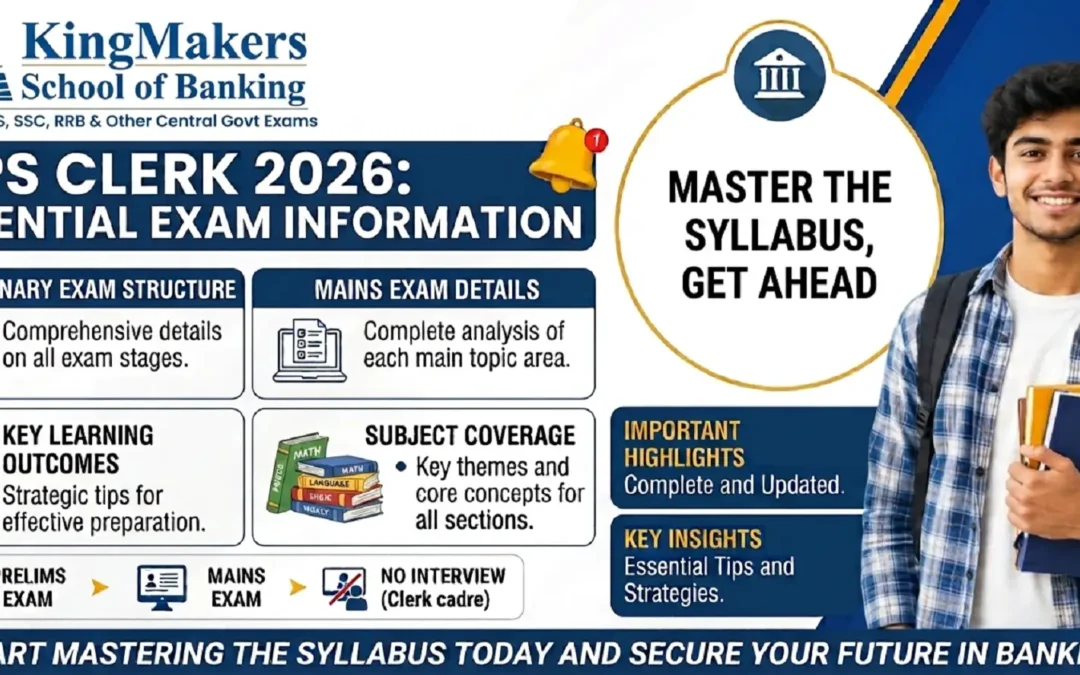
Here’s the part many aspirants misunderstand: there is no interview in the IBPS Clerk selection process. You don’t have to prepare for a separate personality test after Mains. Your focus should instead be on clearing Prelims and then maximising your Mains score, because the Main Examination plays the key role in final selection.
Another important point is that Prelims is not the stage where you build your final merit position. Its primary purpose is to get you through to Mains. So, don’t spend all your preparation time chasing a very high Prelims score while leaving Mains-specific areas such as General/Financial Awareness and Computer Aptitude for later.
IBPS Clerk Exam Pattern 2026 (Prelims + Mains)
Before you start preparing topic by topic, understand how the IBPS Clerk Exam Pattern 2026 is structured. The exam is divided into Prelims and Mains, and each stage has its own sections, timing and scoring requirements.
The IBPS Clerk 2026 exam is conducted in two stages: Prelims and Mains. Prelims is the screening stage, while the Mains score is used for the final merit/provisional allotment.
Prelims Pattern
The Prelims paper tests three areas: English Language, Numerical Ability and Reasoning Ability. Each section gets its own 20-minute window, so you cannot carry unused time from one section into another.
Section | Questions | Marks | Duration |
English Language | 30 | 30 | 20 minutes |
Numerical Ability | 35 | 35 | 20 minutes |
Reasoning Ability | 35 | 35 | 20 minutes |
Total | 100 | 100 | 60 minutes |
Each section has a separate 20-minute time limit, so you cannot borrow time from one section to compensate for another. Since Numerical Ability and Reasoning Ability carry 35 marks each compared with 30 marks for English, candidates should maintain a balanced preparation strategy while prioritising their weaker areas.
Negative marking: 0.25 marks deducted per wrong answer, nothing deducted for unattempted questions.
The practical takeaway is simple: don’t chase maximum attempts blindly. With only 20 minutes per section, speed, accuracy and question selection matter just as much as knowing the concepts.
Mains Pattern
This is where the 2026 pattern needs your attention. The latest CRP CSA-XVI pattern has revised the Mains structure to 160 questions for 200 marks in 125 minutes, with separate timing for each section.
Section | Questions | Marks | Duration |
General/Financial Awareness | 40 | 50 | 20 minutes |
General English | 40 | 40 | 35 minutes |
Reasoning Ability | 40 | 60 | 35 minutes |
Quantitative Aptitude | 40 | 50 | 35 minutes |
Total | 160 | 200 | 125 minutes |
Reasoning carries 60 marks for 40 questions, while General/Financial Awareness and Quantitative Aptitude each carry 50 marks for 40 questions. So the number of questions alone doesn’t tell you the actual weightage of a section.
Each section has its own clock, which means you cannot save five minutes in English and use them in Quant or Reasoning. That makes section-wise time management an important part of Mains preparation.
Negative Marking: The 0.25-mark negative marking applies to wrong answers in the objective tests. There is no penalty for leaving a question unanswered.
So, the better strategy isn’t to attempt everything. It is to maximise your correct attempts while keeping avoidable mistakes under control.
IBPS Clerk Exam Subject-Wise Syllabus Overview
Stage | Subjects |
Prelims | English Language, Numerical Ability and Reasoning Ability |
Mains | Reasoning Ability and Computer Aptitude, English Language, Quantitative Aptitude and General/Financial Awareness |
The Preliminary Examination is mainly about speed and accuracy. The Main Examination requires deeper preparation, especially in Reasoning, Quantitative Aptitude and General/Financial Awareness.
IBPS Clerk Prelims Syllabus 2026
The Preliminary Examination has three sections:
- English Language
- Numerical Ability
- Reasoning Ability
The latest official IBPS notification gives 30 questions in English, 35 in Numerical Ability and 35 in Reasoning Ability, for a total of 100 questions and 100 marks. Each section has 20 minutes.
English Language Syllabus
Topic | Concepts Covered |
Reading Comprehension | Factual, inference-based, vocabulary, tone and main-idea passages |
Cloze Test | Contextual vocabulary, grammar and logical word selection |
Error Detection | Grammar, sentence structure, subject-verb agreement and usage errors |
Fill in the Blanks | Single, double and multiple fillers based on context |
Sentence Improvement | Grammar correction, sentence structure and contextual accuracy |
Phrase Replacement | Replacing incorrect phrases with grammatically suitable alternatives |
Para Jumbles | Sentence sequencing and logical paragraph formation |
Sentence Rearrangement | Arranging sentences in the correct logical order |
Vocabulary | Word meanings, contextual usage and commonly tested words |
Synonyms | Finding words with similar meanings |
Antonyms | Finding words with opposite meanings |
Idioms and Phrases | Understanding common expressions and their meanings |
Word Usage | Identifying the correct use of similar or confusing words |
Connectors | Understanding logical relationships between sentences |
Sentence Completion | Completing sentences logically and grammatically |
How to Prepare English
Do not try to memorise hundreds of grammar rules at once.
Start with basic grammar and read English every day. Practice short reading passages and learn new words through their usage.
For example, instead of only learning the meaning of a word, try to understand how that word is used in a sentence.
Numerical Ability Syllabus
Topic | Concepts Covered |
Simplification | BODMAS, fractions, decimals, percentages and basic calculations |
Approximation | Rounding values and finding approximate answers |
Number Series | Missing numbers, wrong numbers and pattern-based series |
Quadratic Equations | Factorisation, roots and comparison of equations |
Percentage | Percentage increase, decrease, comparison and applications |
Ratio and Proportion | Ratios, proportions and direct or inverse relationships |
Average | Simple, weighted and combined averages |
Profit and Loss | Cost price, selling price, profit, loss and percentage |
Simple Interest | Principal, rate, time and interest calculations |
Compound Interest | Compound interest, amount and different compounding periods |
Time and Work | Work efficiency, combined work and completion time |
Pipes and Cisterns | Filling, emptying and combined pipe problems |
Speed, Time and Distance | Speed, distance, time and relative speed |
Boats and Streams | Upstream, downstream and still-water speed |
Problems on Ages | Present, past and future age relationships |
Partnership | Investment, time period and profit-sharing calculations |
Mixture and Allegation | Mixture ratios, replacement and concentration problems |
Mensuration | Area, perimeter, volume and basic geometric calculations |
Probability | Basic probability and favourable outcomes |
Permutation and Combination | Arrangements, selections and counting methods |
Data Sufficiency | Checking whether the given information is sufficient |
Data Interpretation | Tables, charts, graphs and calculation-based data questions |
You do not need to start with difficult questions. First improve your calculation speed and learn the basic formulas. Then move to mixed and time-based questions.
Reasoning Ability Syllabus
Topic | Concepts Covered |
Puzzles | Floor, box, scheduling, designation, comparison, distribution and mixed-variable puzzles |
Seating Arrangements | Linear, circular, square, rectangular, parallel-row and uncertain-number arrangements |
Inequality | Direct, coded and multiple-statement inequality |
Syllogism | Conclusions, possibility cases and statement relationships |
Coding-Decoding | Traditional, conditional, substitution and pattern-based coding |
Blood Relations | Family trees, coded relations and generation-based relationships |
Direction Sense | Direction, distance, turns and final position |
Order and Ranking | Position, comparison, total persons and rank from different ends |
Alphanumeric Series | Letter, number and symbol sequences |
Input-Output | Step-based arrangements of words, letters and numbers |
Data Sufficiency | Checking whether statements provide enough information |
Analogy | Finding relationships between words, numbers or letters |
Classification | Identifying the odd item based on a common pattern |
Statement and Conclusion | Identifying conclusions that logically follow from statements |
Statement and Assumption | Identifying assumptions behind given statements |
Cause and Effect | Understanding logical relationships between events |
IBPS Clerk Mains Syllabus 2026
The Main Examination goes beyond the basic concepts tested in Prelims.
The four major sections are:
- General/Financial Awareness
- General English
- Reasoning Ability
- Quantitative Aptitude
The latest 2026 pattern also places significant marks on Reasoning and Quantitative Aptitude, so candidates should not ignore these sections while preparing for Prelims.
General/Financial Awareness Syllabus
Topic | Concepts Covered |
Current Affairs | National, international, banking, economic and recent important events |
Banking Awareness | Banking structure, functions, services and basic banking concepts |
Reserve Bank of India | RBI functions, monetary policy, regulations and banking supervision |
Banking Terms | NPA, KYC, CASA, CRR, SLR, repo rate, bank rate and other terms |
Monetary Policy | Repo rate, reverse repo rate, CRR, SLR and liquidity management |
Financial Awareness | Financial concepts, markets, institutions and financial services |
Government Schemes | Important government schemes related to banking, finance and welfare |
Digital Banking | UPI, NEFT, RTGS, IMPS, mobile banking and internet banking |
Financial Inclusion | Banking access, financial literacy and inclusion schemes |
Banking Institutions | RBI, NABARD, SIDBI, SEBI, EXIM Bank and other institutions |
International Institutions | IMF, World Bank, ADB, WTO and other global organisations |
Indian Economy | GDP, inflation, fiscal policy, monetary policy and economic developments |
Union Budget | Important announcements, allocations, taxation and financial measures |
Economic Survey | Major economic trends, reports and key findings |
Reports and Indexes | Important national and international reports and rankings |
Static GK | Capitals, currencies, headquarters, places and organisations |
Awards and Honours | Important national and international awards |
Sports | Major tournaments, winners, players and sporting events |
Books and Authors | Important books, authors and literary events |
Appointments | Important appointments in government, banking and organisations |
Important Days | National and international days and their themes |
How to Prepare General & Financial Awareness
Do not wait until after Prelims to start this section.
Spend a small amount of time every day reading current affairs. Focus especially on banking, finance, economy, government schemes and important national events.
A useful approach is to revise monthly current affairs instead of trying to remember everything from daily news.
General English Syllabus
Topic | Concepts Covered |
Reading Comprehension | Factual, inference-based, vocabulary, tone and main-idea passages |
Cloze Test | Contextual vocabulary, grammar and logical word selection |
Error Detection | Grammar, sentence structure, subject-verb agreement and usage errors |
Sentence Improvement | Grammar correction, sentence structure and contextual accuracy |
Fill in the Blanks | Single, double and multiple fillers based on context |
Para Jumbles | Sentence sequencing and logical paragraph formation |
Sentence Rearrangement | Correct order and logical flow of sentences |
Phrase Replacement | Replacing incorrect phrases with suitable alternatives |
Vocabulary | Word meanings, contextual usage and commonly tested words |
Synonyms and Antonyms | Similar and opposite meanings in different contexts |
Idioms and Phrases | Meaning and usage of common English expressions |
Word Usage | Correct usage of confusing and similar words |
Connectors | Logical relationships between sentences and ideas |
Inference-Based Questions | Understanding information indirectly suggested by a passage |
Sentence Completion | Completing sentences logically and grammatically |
Grammar | Tenses, articles, prepositions, conjunctions, pronouns and modifiers |
What You Should Focus On
Reading speed becomes important in Mains.
Try to read one English article or editorial every day. While reading, focus on:
- Main idea
- Important facts
- Author’s opinion
- Meaning of words from context
- Inference
- Tone of the passage
This will help you in both Reading Comprehension and vocabulary-based questions.
Reasoning Ability Syllabus
Topic | Concepts Covered |
Advanced Puzzles | Floor, box, scheduling, designation, comparison and distribution puzzles |
Seating Arrangements | Linear, circular, square, rectangular, parallel-row and mixed arrangements |
Syllogism | Conclusions, possibility cases, either-or cases and statement relationships |
Inequality | Direct, coded and multiple-statement inequalities |
Coding-Decoding | Conditional, substitution, coded and pattern-based coding |
Blood Relations | Family trees, coded relationships and generation-based questions |
Direction Sense | Distance, turns, directions and final positions |
Order and Ranking | Ranks, positions, comparisons and total persons |
Input-Output | Multi-step arrangements involving words, numbers and letters |
Data Sufficiency | Evaluating whether statements provide enough information |
Logical Reasoning | Statements, arguments, assumptions, conclusions and inferences |
Statement and Conclusion | Identifying valid conclusions from given statements |
Statement and Assumption | Identifying assumptions supporting a statement |
Cause and Effect | Understanding logical relationships between events |
Decision Making | Selecting suitable options based on given conditions |
Critical Reasoning | Evaluating arguments, assumptions and logical relationships |
Alphanumeric Series | Mixed sequences involving letters, numbers and symbols |
Important Tip
Do not spend too much time trying to solve one difficult puzzle.
In the actual exam, first identify the questions you can solve confidently. Build your score with easier questions before attempting lengthy sets
Quantitative Aptitude Syllabus
Topic | Concepts Covered |
Simplification | BODMAS, fractions, decimals, percentages and arithmetic operations |
Approximation | Rounding values and solving calculations using approximate methods |
Number Series | Missing number, wrong number and pattern-based series |
Quadratic Equations | Roots, factorisation and comparison of quadratic equations |
Percentage | Percentage change, comparison, increase, decrease and applications |
Ratio and Proportion | Ratios, proportions and direct or inverse relationships |
Average | Simple, weighted and combined averages |
Profit and Loss | Cost price, selling price, profit, loss and percentage calculations |
Discount | Marked price, discount percentage and selling price |
Simple Interest | Principal, rate, time and interest calculations |
Compound Interest | Compound interest, amount and different compounding periods |
Partnership | Investment, time period and profit-sharing ratios |
Mixture and Allegation | Mixture ratios, replacement and concentration problems |
Time and Work | Work efficiency, combined work and completion time |
Pipes and Cisterns | Filling, emptying and combined pipe efficiency |
Speed, Time and Distance | Speed, distance, time and relative speed |
Boats and Streams | Upstream, downstream and still-water calculations |
Trains | Train length, speed, crossing and relative-motion problems |
Problems on Ages | Age relationships involving past, present and future ages |
Mensuration | Area, perimeter, volume and geometric measurements |
Probability | Events, outcomes and basic probability calculations |
Permutation and Combination | Arrangements, selections and counting techniques |
Data Sufficiency | Determining whether the available data is sufficient |
Data Interpretation | Tables, bar graphs, line graphs, pie charts and caselets |
Caselet DI | Paragraph-based numerical data and calculations |
Missing DI | Finding missing values using available information |
Mixed DI | Combining different types of numerical data |
Data Interpretation Syllabus
Topic | Concepts Covered |
Table DI | Percentage, ratio, average and comparison using tabular data |
Bar Graph | Comparing quantities, changes and percentage calculations |
Line Graph | Understanding trends, changes and comparisons over time |
Pie Chart | Ratios, percentages and distribution of values |
Caselet DI | Extracting numerical information from paragraph-based data |
Missing DI | Finding missing values from incomplete data |
Mixed DI | Combining tables, graphs and multiple data formats |
IBPS Clerk Prelims vs Mains Syllabus
Area | Prelims | Mains |
English | Basic to moderate | More reading and application |
Reasoning | Basic concepts + puzzles | Advanced puzzles + logical reasoning |
Mathematics | Numerical Ability | Quantitative Aptitude |
General Awareness | Not tested | Important |
Financial Awareness | Not tested | Important |
Computer Aptitude | Not a separate Prelims section | Covered with the Mains reasoning component in the notified pattern |
Difficulty | Basic to moderate | Moderate to advanced |
Main Focus | Speed and accuracy | Accuracy, speed and deeper understanding |
Most Important Topics for IBPS Clerk 2026
English
- Reading Comprehension
- Cloze Test
- Error Detection
- Fillers
- Para Jumbles
- Vocabulary
- Grammar
Reasoning
- Puzzles
- Seating Arrangement
- Syllogism
- Inequality
- Coding-Decoding
- Blood Relations
- Direction Sense
- Input-Output
Numerical Ability / Quantitative Aptitude
- Simplification
- Number Series
- Percentage
- Ratio
- Average
- Profit and Loss
- Time and Work
- Speed, Time and Distance
- Data Interpretation
- Simple and Compound Interest
General & Financial Awareness
- Banking Awareness
- Current Affairs
- RBI
- Banking Terms
- Government Schemes
- Financial Institutions
- Monetary Policy
- Digital Banking
- Economy and Budget
Preparation Strategy & Exam Tips
- Understand the complete syllabus before you start. Break English, Reasoning, Numerical Ability, Quantitative Aptitude, and General/Financial Awareness into smaller topics so your preparation stays organised.
- Build your basics first, then increase difficulty. Start with topics such as simplification, percentage, syllogism, grammar, and basic reading comprehension before moving to lengthy puzzles, advanced DI, and difficult reasoning sets.
- Practice Prelims with the sectional time limits. Each Prelims section has its own 20-minute window, so practise English, Numerical Ability, and Reasoning separately instead of relying only on full-length mocks.
- Start Mains preparation along with Prelims. Do not wait for the Prelims result to begin General and Financial Awareness. Build a daily habit of reading current affairs and revising banking-related topics from the beginning.
- Give extra attention to your weak subjects. Do not spend all your study time on subjects you already enjoy. Use mock-test results to identify weak areas and give them regular practice until your accuracy improves.
- Use previous-year questions to understand the actual exam level. PYQs show you the types of questions IBPS asks repeatedly and help you understand which topics deserve more practice.
- Improve speed without sacrificing accuracy. Practise calculations, learn useful shortcuts after understanding the concepts, and use timed quizzes to become faster while keeping your mistakes under control.
- Take mock tests regularly and analyse every mistake. Do not focus only on your score. Check which questions took too long, which concepts caused errors, and which questions you should have skipped.
- Keep a regular revision cycle. Revise formulas, grammar rules, vocabulary, banking terms, current affairs, and your previous mistakes every week instead of trying to remember everything just before the exam.
- Prepare for Mains from day one. Prelims is only the first stage, so build your preparation around both stages. Strong basics, regular practice, current-affairs revision, and mock-test analysis will make the transition to Mains much easier.
Other IBPS Exam Guides
- IBPS Clerk Notification
- IBPS Clerk Eligibility Criteria
- IBPS Clerk Exam Pattern
- IBPS SO Notification 2026
- IBPS PO Notification 2026
- IBPS PO Eligibility Criteria
- IBPS PO Syllabus 2026
- How to get bank job in 2026
Want a Structured IBPS Clerk Preparation Plan?
The IBPS Clerk Syllabus 2026 covers everything from English, Reasoning, and Numerical Ability in Prelims to Quantitative Aptitude and General/Financial Awareness in Mains. The key is not to study every topic at once, but to build your preparation step by step. Strengthen your basics first, practise questions regularly, and gradually move to timed sectional tests and full-length mocks. Start your current affairs and banking awareness preparation early, so you are not trying to cover the Mains syllabus after Prelims. With consistent practice, regular revision, and proper mock-test analysis, you can improve both your speed and accuracy and approach the IBPS Clerk exam with greater confidence.
Frequently Asked Questions
The IBPS Clerk syllabus covers English, Numerical Ability, Reasoning, Quantitative Aptitude, and General/Financial Awareness across Prelims and Mains.
IBPS Clerk has no interview stage. SBI Clerk also does not have a regular interview.
Yes, if you have strong basics and follow a focused study plan with daily practice, mock tests, and revision.
Yes. IBPS Clerk 2026 (CRP-CSA-XVI) is scheduled, with Prelims in October and Mains in December 2026.
IBPS Clerk and SBI Clerk are good options for freshers because they have no regular interview stage.
Both have similar difficulty levels. The easier exam depends on vacancies, cut-offs, competition, and your preparation.
It can be challenging because of time limits and competition, but regular practice and proper planning can make preparation manageable.
There is no fixed safe score. It varies by state, category, vacancies, and exam difficulty. Aim well above the expected cut-off.
IBPS Clerk recruitment is generally conducted once a year, with Prelims and Mains held as separate stages.
For most aspirants, 3–6 months of consistent preparation is a good target. Beginners may need additional time for building basics.